

AI Agents in 2026: A Complete Beginner-Friendly Guide
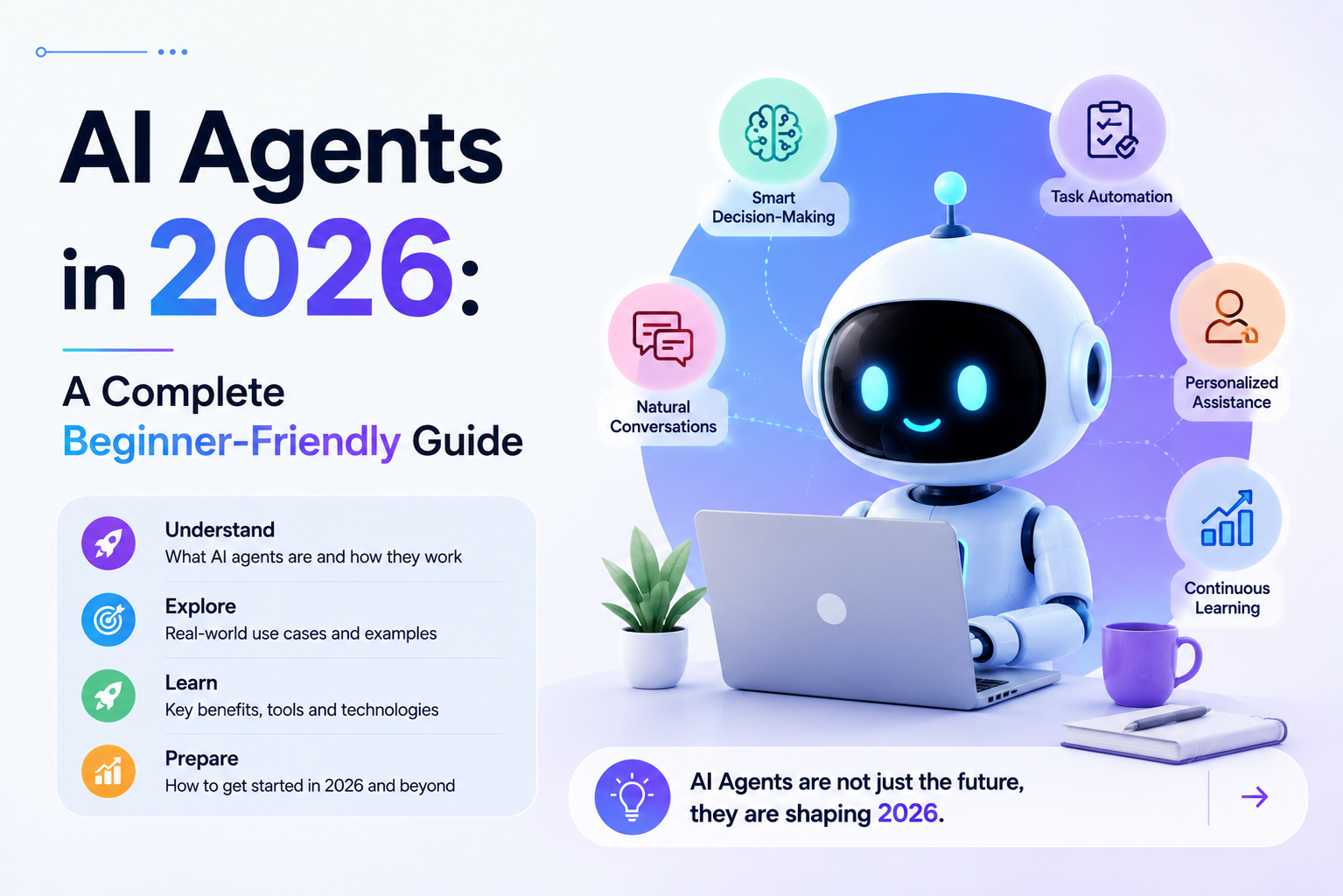
Type “AI agent” into a search bar in 2024 and you’d mostly get developer documentation. Type it today and you get banking apps that handle millions of conversations a month, supply chain systems running across thousands of stores without a human clicking “approve,” and a market that Gartner expects to power 40% of enterprise software by the end of this year. Something genuinely shifted, and it happened fast enough that a lot of people are still catching up on what an AI agent actually is, why businesses suddenly can’t stop talking about them, and whether any of this changes life for the rest of us who aren’t running a Fortune 500 company.
This guide is the starting point. We’ll walk through what separates an agent from the chatbot you already use, how groups of agents are starting to work together like a small team rather than a single tool, what’s actually happening inside companies that have deployed them (with real names and real numbers, not just predictions), the myths worth dropping, and where this technology is quietly showing up on your own phone. Each section below links to a deeper, dedicated article if you want to go further on any one piece.
So What Actually Is an AI Agent? (Full guide)
The simplest way to think about it: a chatbot answers, an agent acts. When you ask ChatGPT or Gemini a question, it gives you a response and then waits for your next move. An AI agent, by contrast, takes a goal, works out the steps needed to get there, uses whatever tools it has access to, and keeps going until the job is done or it hits a point where it genuinely needs a human to weigh in. MIT Sloan researchers describe this as the shift from AI that talks to AI that does — agents perceive a situation, reason about it, and take action with little or no supervision along the way.
That distinction matters more than it sounds. A customer support chatbot might suggest three possible answers to a billing question. An agent doing the same job pulls up the customer’s account, checks the payment history, applies the refund according to policy, and sends the confirmation email — without anyone needing to copy information between systems. It’s the same underlying language model in both cases. What’s different is the agent has been given memory, tools, and a license to actually finish the task. Our deeper breakdown of how AI agent development is changing enterprise automation goes further into the mechanics, if you want the fuller picture.
When Agents Stop Working Alone (Full guide)
The next layer that’s reshaping things in 2026 is multi-agent systems — instead of one general-purpose agent trying to do everything, companies are building small teams of specialized agents that hand work off to each other. Think of it less like hiring one assistant and more like running a small department: one agent researches, another drafts, a third checks the work, and a supervising agent coordinates the handoffs.
This isn’t theoretical. Genentech has built agent ecosystems on AWS specifically so its scientists can focus on drug discovery instead of repetitive research workflows. Walmart runs a supply chain agent that ingests live sales data from roughly 4,700 stores and fulfillment centers and makes restocking decisions on its own, without a human sign-off at every step. Amazon used a coordinated set of agents to modernize thousands of legacy Java applications in a fraction of the time a human engineering team would have needed. The pattern across all of these is the same: specialized agents, working in parallel, covering more ground than a single system ever could on its own.
What This Looks Like Inside Real Companies (Full guide)
It’s easy to be skeptical of AI hype, and plenty of it deserves skepticism. But the agent space in 2026 has something a lot of past AI trends didn’t have early on: named companies reporting specific, measurable outcomes rather than vague promises.
Klarna’s customer service agent has handled work equivalent to roughly 853 full-time employees, and the company has publicly said it saved tens of millions of dollars doing it — though Klarna later rebalanced toward a mix of AI and human agents once it found that complex, emotionally charged customer issues still needed a person’s judgment, which is a useful reminder that “autonomous” doesn’t mean “unsupervised forever.” JPMorgan reportedly runs more than 450 agentic AI use cases in production every day, spanning everything from fraud checks to internal operations. Salesforce has used contract-review agents to cut millions in legal costs by flagging risks in documents before they ever reach a lawyer’s desk.
Industry surveys back up that this isn’t a handful of outliers. Google Cloud found 88% of early adopters of agentic AI saw a return on investment from at least one use case, and separate reporting puts average ROI from agent deployments meaningfully above what companies typically see from older, rule-based automation. That said, it’s not universal success — a widely cited BCG survey found a large share of companies scaling AI projects still aren’t capturing significant value, which is the honest counterweight to the success stories above. The technology works; not every rollout does. For a closer look at how individual AI tools fit into this shift, see our coverage of ChatGPT’s features and everyday use cases and what sets Google Gemini apart.
The Myths Worth Retiring (Full guide)
Three claims come up constantly, and all three deserve a more careful answer than a flat yes or no.
“Agents are coming for everyone’s job.” What’s actually happening at most companies that have deployed agents is narrower: repetitive, well-defined tasks get automated, and the people who did them move toward judgment calls, exceptions, and the work that still needs a human in the loop. Klarna’s own experience — automating heavily, then deliberately bringing humans back in for nuanced cases — is a more realistic preview than either “robots will replace us” or “nothing will change.”
“You need the most advanced model to build something useful.” Practitioners building production agents have found that system design — clear instructions, the right tools, sensible guardrails — usually matters more than raw model size. A well-scoped agent on a smaller model often outperforms a poorly scoped one on a flagship model.
“Agents still hallucinate too much to trust.” That was a fair criticism in 2024. With structured outputs, human checkpoints at the right moments, and narrower task scopes, production agents on well-defined jobs are now reporting considerably higher reliability — though “well-defined” is doing a lot of work in that sentence. Open-ended, ambiguous tasks remain a genuinely harder problem, and treating every agent as equally trustworthy regardless of scope is its own mistake.
The Part That Touches Your Everyday Life (Full guide)
Enterprise deployments get the headlines, but the more personal shift is agents moving onto the devices people already carry. Apple, Qualcomm, and Google have all pushed on-device agent frameworks that don’t need a constant cloud connection — meaning an assistant on your phone can draft a message, manage a calendar conflict, or adjust a smart home setting locally, with less of your data leaving the device and less lag while it thinks.
You’ve probably already brushed up against a simpler version of this. Banking apps like Bank of America’s Erica have walked customers through balance checks and bill payments for years; that’s a narrow, well-behaved agent doing one job reliably. What’s changing now is the scope — the same underlying idea, applied to more of the small, annoying admin that fills up a day. If you’re curious how the everyday AI tools you might already use compare to each other, our pieces on Perplexity AI’s research-focused features and Notion AI’s productivity tools are a good next stop, and our roundup of AI tools worth trying in daily life covers the more consumer-facing side of this shift.
Frequently Asked Questions
Are AI agents just chatbots with a new name?
No. A chatbot’s job ends when it gives you an answer. An AI agent takes that answer and acts on it — checking a database, completing a transaction, sending a follow-up — without needing you to manually carry the result to the next step.
Will AI agents replace human jobs?
The evidence so far points to task automation rather than wholesale job replacement, with the repetitive parts of a role shifting to an agent while the judgment-heavy parts stay with a person. Klarna’s reversal toward a hybrid model after going AI-heavy on customer service is one of the clearer real-world examples of where that line tends to land.
Are AI agents safe to use for sensitive tasks?
It depends heavily on how narrowly the agent is scoped and what checkpoints exist. Well-defined, permissioned tasks with human review at key decision points have shown strong reliability in production. Open-ended tasks with no oversight are a different risk profile entirely, and most serious deployments treat them that way.
Do I need to be a developer to use AI agents?
Not anymore for the consumer side — banking, productivity, and personal-assistant agents are already built into apps most people use. Building a custom agent for a business workflow still benefits from technical support, though no-code platforms have lowered that bar considerably.
What’s the difference between an AI agent and “agentic AI”?
An AI agent is one system performing a specific task. Agentic AI is the broader design philosophy — building software around autonomous, multi-step action instead of single-turn responses. One is the building block; the other is the architecture.
The honest summary: AI agents in 2026 aren’t science fiction and they aren’t a solved problem either. They’re a genuinely useful, still-maturing technology with real wins, real failures, and a fast-growing footprint in both boardrooms and back pockets. The five articles linked above each dig into one piece of that picture in more depth — start wherever your curiosity is strongest.
