

What Are AI Agents? A Simple Explanation for 2026
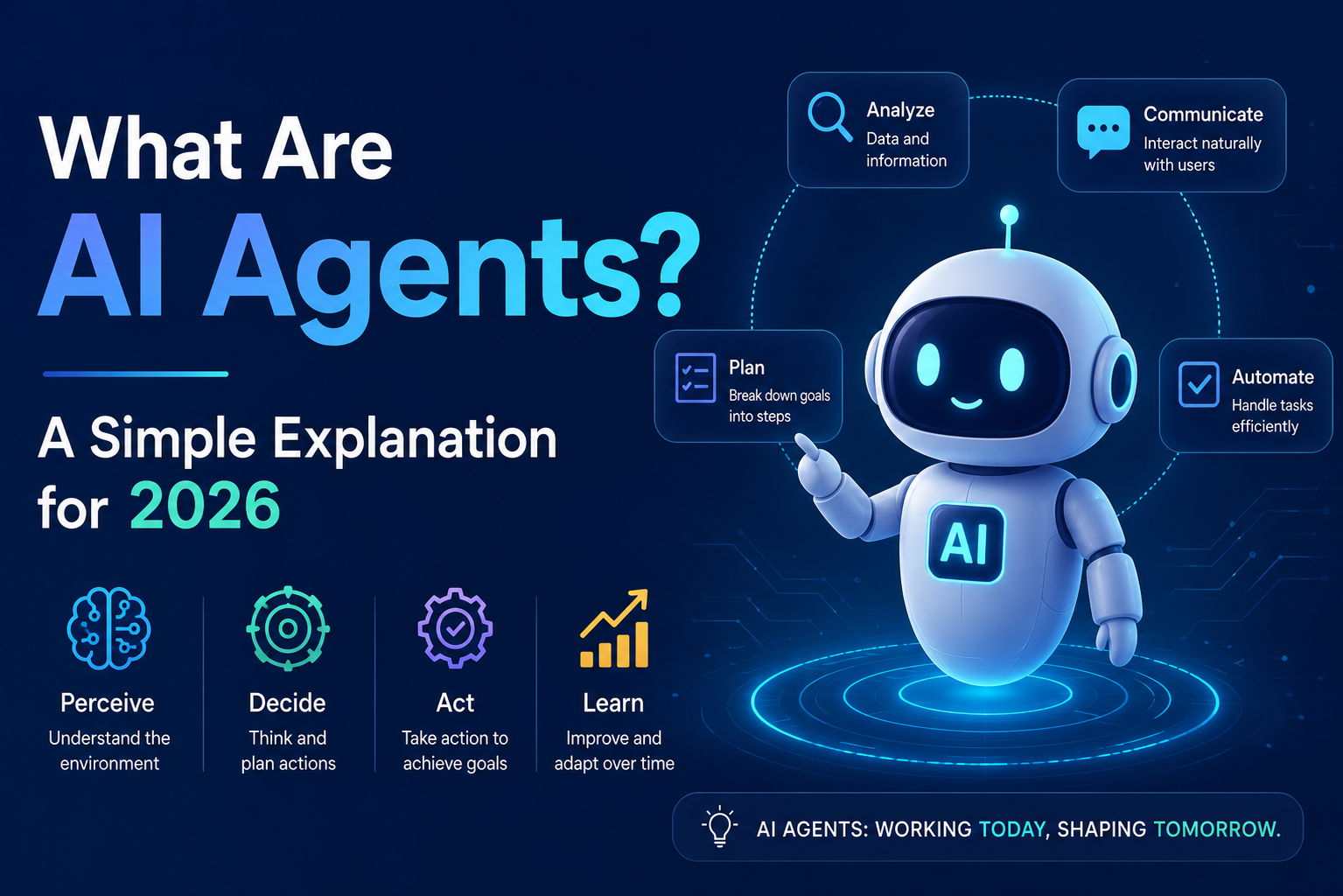
Ask five different people what an AI agent is and you’ll probably get five different answers — and at least two of them will accidentally describe a chatbot instead. That mix-up is everywhere right now. Every AI company has started calling its product an “agent,” which has made the term almost meaningless unless you know the actual distinction underneath the marketing.
Here’s the short version, the one worth remembering before anything else: chatbots talk, copilots suggest, and agents act. A chatbot answers your question and stops. A copilot watches what you’re doing and offers a suggestion you still have to approve. An AI agent takes a goal, figures out the steps on its own, uses whatever tools it has access to, and keeps working until the job is actually finished — not just discussed.
The Three-Way Confusion, Cleared Up
Microsoft’s own explainer puts it plainly: a chatbot is designed to simulate conversation, often through scripted or rule-based responses, and it tends to struggle the moment a request gets complicated or veers off-script. An AI agent, on the other hand, is autonomous and goal-driven — it can reason through a multi-step task, adapt as it goes, and learn from what it encounters along the way. Microsoft’s Copilot is actually a kind of agent by this definition, which is part of why the lines get blurry in everyday conversation.
Copilots sit in their own middle category. GitHub Copilot watches you write code and predicts what comes next; Notion AI sits inside your notes and drafts a paragraph when you ask. Both are genuinely useful, and both share one defining limit: they suggest, and a human still has to accept or reject every suggestion before anything happens. An agent removes that approval step for routine, well-defined work. It doesn’t wait for you to click “accept” on every line — it completes the task and reports back.
A Simple Example You’ve Probably Already Used
You don’t need an enterprise deployment to have already met a basic AI agent. Amazon Alexa turning your smart lights on automatically at sunset is a simple, rule-bound version of one — it perceives a condition (the time of day), decides on an action, and executes it without you asking each evening. It’s a narrow agent with one job, but the underlying pattern — perceive, decide, act — is the same pattern running underneath the far more capable systems showing up in banking apps and customer service tools today.
The more advanced version of that same pattern looks like this: you tell an agent to research a topic, and instead of just summarizing what it already knows, it searches the web, pulls information from multiple sources, cross-checks the details, and hands you a finished writeup — the way a research assistant would, not the way a search engine would. Microsoft has reported that people using Copilot for this kind of task save an average of roughly 1.5 hours a week on administrative work alone, which is a small but concrete sign of what the shift from “answering” to “doing” actually saves in practice.
Why the Word “Agent” Got So Overused
Part of the present confusion is that the market stretched the word past its original meaning. Chatbots got smarter and started being marketed as agents. Automation tools added a single AI-generated step and called themselves agentic. By one estimate from Gartner, only a small fraction of the vendors currently claiming agentic AI capabilities — roughly 130 out of thousands — are building something that meets the actual technical bar. Anthropic, the company behind Claude, draws the line this way: a workflow is a system where the code decides what happens next, while an agent is a system where the model itself decides what happens next and keeps that control across the task. That’s a genuinely useful test if you’re trying to tell a real agent from a relabeled script.
If you want to see what a working agent looks like once it’s deployed at scale rather than described in theory, our piece on how AI agent development services are transforming enterprise automation walks through real production examples. And if you’re trying to place where today’s biggest chat-based tools fit on this spectrum, we’ve also covered ChatGPT’s features and everyday use cases and how Perplexity AI approaches research differently in separate guides.
How to Tell What You’re Actually Using
A practical way to check, without needing any technical background: ask who makes the final call. If a tool only ever talks back to you in a chat window and can’t open a file, send an email, or touch any system outside that window, it’s a chatbot, full stop. If it sits inside an app you’re already using, watches your context, and offers a suggestion you have to click to accept, it’s a copilot. If it takes a goal, plans its own steps, calls on outside tools or data, and finishes the job without asking you to approve every individual move, that’s an agent. The deciding question isn’t how smart the system sounds — plenty of chatbots sound very smart. It’s how much it’s allowed to do without you in the loop.
This distinction is also why “agent washing” — the practice of rebranding an existing chatbot as an agent without changing what it can actually do — has become enough of a problem that analysts now write about it directly. The technology behind genuine agents is real and the gains being reported are real, but the labeling around it hasn’t caught up, so a healthy amount of skepticism toward any product simply because it uses the word “agent” in its name is a reasonable starting point.
Frequently Asked Questions
What is the simplest definition of an AI agent?
An AI agent is software that takes a goal, decides the steps needed to reach it, uses available tools, and completes the task with little or no step-by-step approval from a person — as opposed to a chatbot, which only answers and waits for your next message.
Is ChatGPT an AI agent or a chatbot?
On its own, standard ChatGPT behaves mostly like a chatbot — it answers in a request-response pattern. When it’s given the ability to browse, run code, or use connected tools and complete multi-step tasks on its own, that mode moves it toward agent behavior. The underlying model is the same; what changes is how much autonomy and tool access it’s been given.
What’s a real-life example of an AI agent that isn’t a business tool?
A smart home routine like Alexa or Google Home turning on lights at sunset, or a banking app’s assistant walking you through a balance check and bill payment without you opening a separate app, are both simple, narrow examples most people have already used without thinking of them as “agents.”
Are AI agents and copilots the same thing?
No. A copilot suggests an action and waits for you to approve it — it’s embedded in one specific app and stays there. An agent can act across multiple systems on its own and doesn’t need approval for each individual step, only for the overall task it’s been given.
Why does everyone suddenly call their product an “AI agent”?
Because the term has real commercial pull right now, many products that are really just smarter chatbots or single-step automations have been relabeled as agents. Checking whether a tool can actually complete a multi-step task without your constant input is a reliable way to tell the difference.
None of this makes the older tools obsolete — a chatbot is still the right choice for a quick question, and a copilot is still the better fit when you want a human reviewing every step. The point of knowing the difference isn’t to chase the newest label. It’s to pick the right level of help for the task actually in front of you.
