

When Agents Stop Working Alone: Multi-Agent Systems in 2026
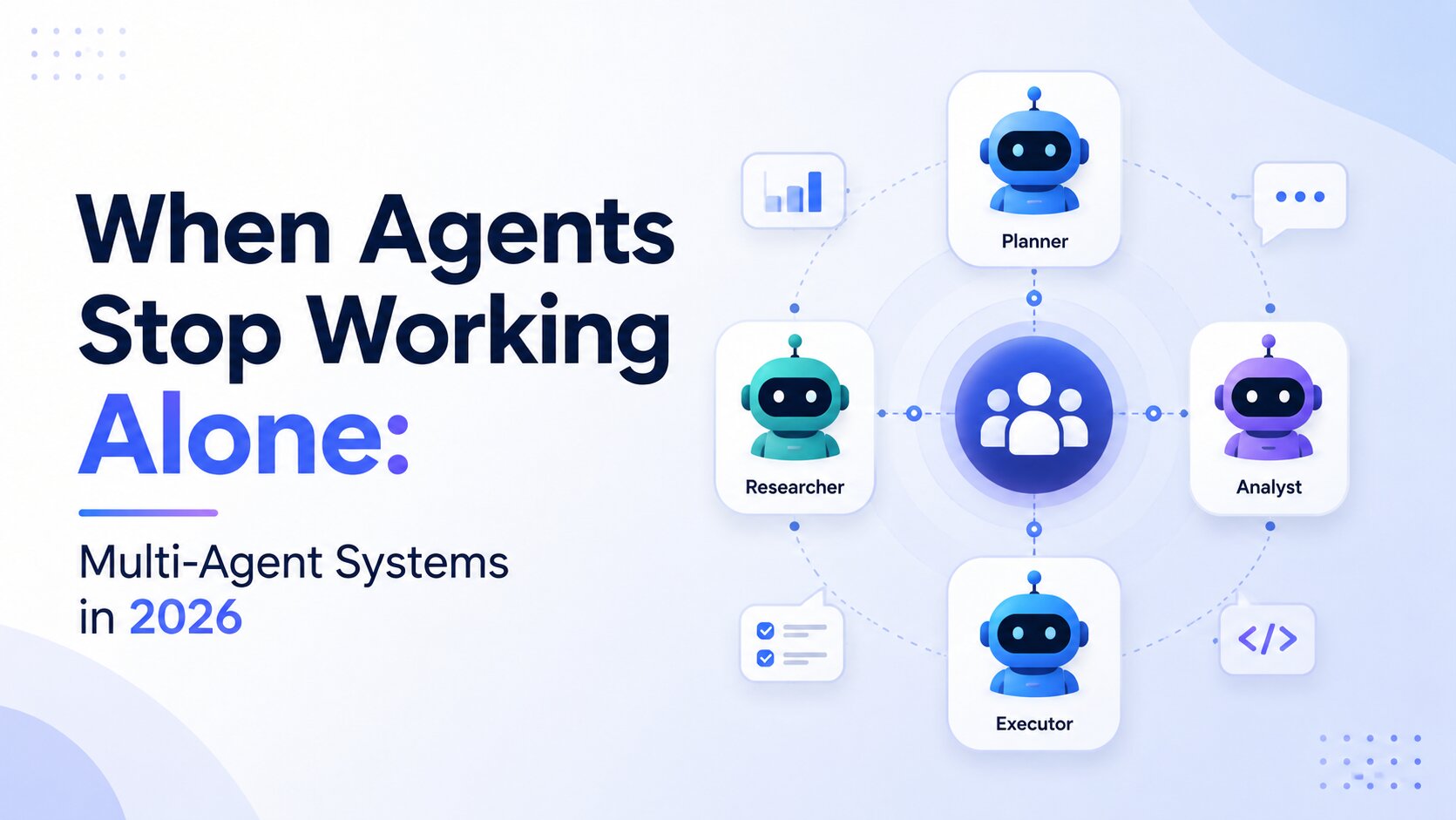
For most of 2024, “AI agent” meant one thing: a single assistant that took a goal and ran with it. By 2026, that picture is already outdated. Forrester and Gartner now describe this as the breakout year for a different architecture entirely — networks of specialized agents that split a job into pieces, hand work to each other, and report back through a coordinating layer, the way a real team would rather than a single overworked employee.
The shift matters because the failure modes are completely different. A single agent that gets something wrong fails in one place, in one obvious way. A team of agents that gets something wrong can fail in the handoff between two of them, in a step nobody assigned ownership of, or in a disagreement neither agent was built to resolve. Understanding multi-agent systems means understanding both why companies are racing toward them and why a meaningful share of these projects still don’t survive contact with production. For the basics on what separates an agent from a chatbot in the first place, our explainer on what AI agents actually are is the right starting point before this piece.
Why One Agent Stopped Being Enough
A single general-purpose agent runs into the same wall a single generalist employee does: it can do a lot of things adequately, but it’s rarely the best choice for any one of them. Specialization solves that the same way it does in a human organization. One agent is built and tuned specifically to research a topic, another is built specifically to draft based on that research, a third checks the draft against a rulebook, and a supervising agent decides what happens next when something doesn’t match expectations.
Leaders at AWS and IBM have compared the orchestration layer that coordinates these handoffs to what Kubernetes did for managing containers — infrastructure that nobody outside engineering thinks about directly, but that determines whether the whole system holds together under real load. That comparison is doing real work: orchestration isn’t a feature bolted onto agents after the fact, it’s the layer that decides whether five specialized agents behave like a team or like five people shouting past each other.
The scale of this shift shows up in the numbers. Industry research tracking enterprise deployments found that 22% of production AI systems already coordinate three or more agents rather than running a single model, and the average large enterprise is now operating multiple distinct agents across its workflows, a number expected to roughly double over the next year as orchestration tooling matures. None of this is happening in isolation — it’s tied to a genuine standardization push, most visibly the Model Context Protocol, an open integration standard (now under the Linux Foundation) that lets agents from different vendors talk to the same tools without custom integration work for every pairing. Adoption of that protocol has reportedly crossed several thousand public implementations in the past year alone, which is as good a signal as any that “agents working together” stopped being a research demo and started being infrastructure.
What This Looks Like Inside Real Deployments
Genentech’s approach is a useful case study precisely because it isn’t flashy. Rather than building one assistant for its scientists, the company built an ecosystem of agents on AWS where different agents handle different stages of a research workflow, freeing scientists from the repetitive parts of drug discovery so they can spend more time on the judgment calls that actually require a researcher’s expertise. The win isn’t that one agent is smart — it’s that the division of labor mirrors how a real research team already splits work.
Walmart’s supply chain system tells a similar story at a different scale. The system pulls live sales data from roughly 4,700 stores and fulfillment centers, and rather than one model trying to reason about all of that at once, the workload is split so that forecasting, restocking decisions, and exception-handling are effectively separate jobs running in coordination, only escalating to a human when a restocking decision falls outside normal parameters. JPMorgan runs over 450 agentic AI use cases in production, spanning fraud detection, internal operations, and compliance checks — a number that only makes sense as a portfolio of specialized, narrowly scoped systems rather than one model trying to be the bank’s everything-agent. Amazon’s modernization of thousands of legacy Java applications followed the same pattern: a coordinated set of agents split the analysis, rewriting, and validation work across the codebase in parallel, finishing in a fraction of the time a human engineering team would have needed for the same migration working sequentially.
The thread connecting all three is specialization plus coordination, not raw model capability. None of these companies needed a smarter model to get these results — they needed a better division of labor and a reliable way for the pieces to hand off work without losing context.
The Part Nobody Puts on a Conference Slide
Here’s the honest counterweight to all of that: Gartner expects more than 40% of agentic AI projects to be canceled by 2027, citing escalating costs, unclear ROI, and weak risk controls as the leading causes — and multi-agent systems, with more moving parts than a single agent, carry more of that risk, not less. A coordination layer that isn’t designed carefully doesn’t just fail quietly; it can produce confident, wrong answers when two agents disagree and nothing in the system is built to catch that disagreement before it reaches a customer or a financial ledger.
Governance has become the practical bottleneck more than capability has. Industry surveys now track a sharp rise in companies naming a dedicated “AI agent owner” or “agentic ops” role specifically to manage this risk, up from a small fraction of organizations just two years ago — and that ownership correlates strongly with which companies actually get a multi-agent system into reliable production versus which ones stall in pilot mode indefinitely. A separate, widely cited BCG analysis found that a large share of companies scaling AI projects still aren’t capturing significant measurable value from them, which lines up with what engineers building these systems say privately: the agents themselves usually aren’t the hard part anymore. The hard part is deciding, in advance, exactly which decisions a human still needs to review, and building the system so it actually stops and asks when it hits one of those decisions.
Klarna’s experience is the clearest public example of recalibrating after going too far in one direction. The company’s customer service agent handled work equivalent to roughly 853 full-time employees and produced real, publicly reported cost savings — and then Klarna deliberately rebalanced toward a mix of AI and human agents once it became clear that complex, emotionally charged customer issues still needed a person’s judgment, not just a faster system. That isn’t a failure story. It’s what a mature, monitored deployment looks like when a company is honest about where the line sits.
Myths Worth Retiring
“More agents automatically means faster results.” Not if the coordination layer is weak. Five specialized agents that don’t hand off work cleanly can be slower and less reliable than one well-scoped agent doing the same job alone — the agents aren’t the bottleneck, the orchestration between them is.
“You need a frontier model to run a multi-agent system well.” Practitioners building these systems consistently report that system design — clear task boundaries, the right tools for each specialized agent, and sensible checkpoints — matters more than which underlying model powers any individual agent. A well-architected team of smaller, cheaper models often outperforms one expensive model trying to do everything.
“Once it’s running, it doesn’t need monitoring.” Every well-performing deployment Google Cloud profiled in its 2026 enterprise survey had logging, tracing, and alerting configured before going live, and organizations that skipped that step reported two to three times higher incident rates in their first sixty days. Multi-agent systems compound this risk because an error can travel silently from one agent to the next before anyone notices.
Frequently Asked Questions
How many agents does a multi-agent system actually need?
There’s no fixed number — it depends on how many genuinely distinct sub-tasks the workflow has. Most production deployments in 2026 coordinate somewhere between two and five specialized agents; adding more than that without a clear division of labor tends to create coordination overhead rather than solve it.
What happens when two agents in the same system disagree?
In a well-designed system, a supervising or coordinating agent is responsible for catching that disagreement and either resolving it against a defined rule or escalating it to a human. In a poorly designed one, the disagreement can quietly resolve itself in whichever direction the last agent to act happened to push it, which is exactly the failure mode governance teams are now built to catch.
Is a multi-agent system more expensive to run than a single agent?
Often yes in raw compute terms, since multiple models are running instead of one. Companies offset this by using smaller, cheaper models for narrowly scoped sub-tasks and reserving more capable models for the steps that genuinely need them, rather than running one large model for every piece of the workflow.
Can a small business realistically use multi-agent systems, or is this only for large enterprises?
Turnkey platforms have brought the technical bar down considerably, and smaller companies are adopting agentic tools at a faster year-over-year rate than large enterprises specifically because of that lower barrier. The harder part for a small business usually isn’t access to the technology — it’s having someone responsible for defining where human review still belongs.
Why do so many multi-agent projects get cancelled despite the technology working?
The technology working in a demo and the technology working reliably in production with real governance are different bars. Most cancellations trace back to unclear ROI, escalating costs, or risk controls that weren’t built in from the start — not to the agents themselves failing at their assigned task.
Is multi-agent orchestration the same thing as agentic AI?
Not quite. Agentic AI is the broader category — any system built around autonomous, goal-directed action. Multi-agent orchestration is a specific architecture within that category, where the work is deliberately split across several specialized agents instead of handled by one. You can have agentic AI without multi-agent orchestration, but not the other way around.
The honest takeaway is that multi-agent systems aren’t a more advanced version of a single agent — they’re a different design decision with their own failure modes, their own governance demands, and their own real wins when built carefully. Genentech, Walmart, and JPMorgan show what that looks like when it works. Gartner’s cancellation forecast shows what happens when the coordination layer gets less attention than the agents themselves. For the broader picture of where AI agents stand in 2026, the complete beginner-friendly guide ties this piece back into the full landscape, from enterprise deployments to the agents already quietly running on your phone.
