

Claude vs ChatGPT for Students: Which AI Actually Helps You Learn in 2026?
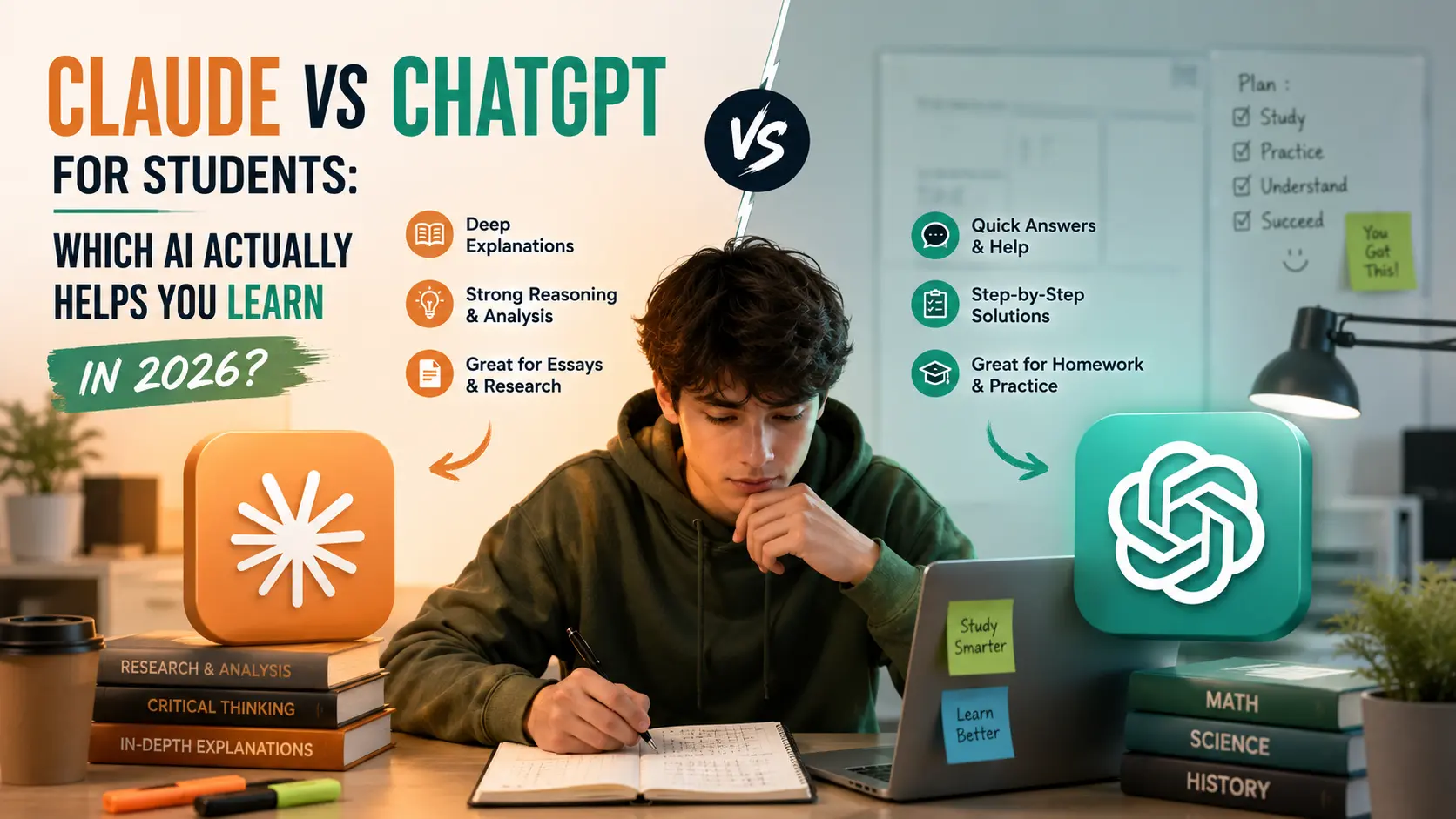
The Assignment Is Due Tonight. Which AI Do You Open?
Every student figures this out eventually, usually around eleven at night with something due at nine the next morning. You open Claude or you open ChatGPT, and honestly, either one will help. But they help differently, and if you’re going to lean on AI through four years of college, or however much of high school you’ve got left, it’s worth knowing which one actually fits the kind of work you do. For the wider comparison covering pricing, writing, and coding, our full Claude vs ChatGPT comparison is a good place to start.
This isn’t about which one writes the essay for you. Neither should, and both will get you in trouble if that’s the plan. It’s about which one actually helps you think better, faster, without leaving the kind of flat, lifeless prose a professor has seen a hundred times already this semester.
Essay and Academic Writing: Where the Difference Actually Shows
Ask both tools to help outline a five-paragraph essay on the causes of the French Revolution and you’ll get two decent outlines back. Ask them to help develop an actual argument, something with a real edge to it, not a textbook summary in disguise, and Claude tends to pull ahead. It asks follow-up questions. It pushes back when your thesis is weak instead of just running with it. ChatGPT will hand you five clean bullet points and move on to whatever you ask next.
That gap matters more the deeper you get into a paper. A five-hundred word reflection? Either tool’s fine here, honestly, don’t sweat it. A senior thesis chapter is a different story. You want something that still remembers what you argued on page twelve when you’re revising page forty at two in the morning.
Research and Source Summarization
Paste in a dense journal article and ask what it’s actually saying, underneath all the academic hedging, and both tools earn their keep here. But Claude’s bigger context window means you can drop in three or four sources at once and ask where they agree and where they quietly contradict each other. That’s the actual research skill your professor is trying to teach you, and having something that holds all of it in memory at the same time speeds up the part of research nobody enjoys doing at midnight.
ChatGPT is genuinely faster for the quick stuff. Define this term. Explain this theory in plain English. One source, one question, done.
Homework Help Across Subjects
For math, stats, problem sets with one clear right answer, ChatGPT’s reasoning models have an edge, they’re built for exactly this kind of step-by-step logic. Essays are different. Literature analysis, historical arguments, anything where the “right answer” isn’t really an answer so much as something you have to build yourself. Claude sounds more like a classmate thinking it through with you there. Less like a summary that wandered in from somewhere else.
And no, neither one should actually be doing your homework for you. Obviously. Used as a tutor that actually explains why an answer works, both are genuinely useful. Used as a shortcut so you never have to understand the material, you’re setting yourself up for a rough final exam, and that’s on you, not the AI.
Plagiarism and Academic Integrity, the Part Nobody Wants to Talk About
Turnitin and similar tools have gotten better. Professors have gotten more suspicious in general too, so this matters more now than it did even a year or two ago. Text that’s heavily AI-generated with barely any editing tends to have a certain flatness to it, and both tools produce that flatness by default the second you copy-paste the output straight in. Claude’s writing is a little less detectable, mostly because it varies sentence structure more naturally on its own. But less detectable isn’t the same thing as safe. Don’t confuse the two.
The actual safe approach, the one that doesn’t blow up in your face during finals week: use either tool to brainstorm, outline, or sanity-check your reasoning, then write the final draft yourself, in your own voice. Professors read a lot of student writing, way more than you’d think, and they remember patterns. If your normal voice suddenly changes halfway through a semester, somebody notices. Every time.
Free Tier Comparison for Budget-Conscious Students
Most students aren’t paying twenty dollars a month for one AI tool, let alone two. Claude’s free tier gives you Sonnet with memory and web search built in, which honestly is more than you’d expect for free. ChatGPT’s free tier gives you GPT-4o but caps out faster during busy periods, and of course that’s exactly when you need it most, midterms, finals week, the week every paper is somehow due at once.
If you can only lean on one free tool through a semester, Claude tends to stretch further for actual coursework. Need image generation for a project or a presentation slide? That’s ChatGPT’s built-in advantage, and for visual assignments it’s not a small one.
Which One Should Students Actually Use?
Heavy on writing, essays, research papers, lit reviews? Claude is worth the small hassle of learning its quirks. Heavy STEM coursework with lots of problem sets, plus the occasional image for a lab report or presentation? ChatGPT probably covers more of what you’ll actually touch on a normal Tuesday. A lot of students end up running both on free tiers, honestly, switching depending on what the assignment actually needs.
The Bottom Line
Neither tool replaces doing the actual reading. Or showing up to office hours, for that matter. Treat either one as a total shortcut and it catches up with you, usually right before some exam that assumes you learned the material you skipped. That said? As a study partner, something to think through an argument with, check your logic, make sense of a dense reading at one in the morning, they’re both worth having open. Just maybe don’t mention to your professor that’s all you did.
Frequently Asked Questions
Q1: Is it cheating to use Claude or ChatGPT for schoolwork?
Depends entirely on your school’s policy and how you actually use it. Brainstorming, outlining, checking your understanding, that’s fine almost everywhere. Having the AI write your submitted essay usually isn’t, and most universities have explicit rules against it now. Check your syllabus before you assume either is fine, seriously.
Q2: Which AI is better for writing essays, Claude or ChatGPT?
Claude tends to produce writing with more natural variation and a stronger argument structure, which makes it the better brainstorming and outlining partner. Just don’t submit its output directly. That’s a separate problem from which tool writes better.
Q3: Can professors tell if I used AI to write my assignment?
They’ve gotten better at it, and honestly a lot of professors can spot that flat AI tone now without even running a detector. The difference between fine and caught, usually, is whether you actually edited it into your own voice or just copy-pasted and called it done.
Q4: Does Claude or ChatGPT have a better free plan for students?
Claude’s free tier tends to go further for actual coursework, memory and web search included at no cost. ChatGPT’s free plan runs out faster during the busy weeks, and somehow that’s always the week you actually needed it.
Q5: Should I use AI to help with math homework?
For step-by-step problem sets, ChatGPT’s reasoning models handle the logic well. Just make sure you’re using it to understand the process and not only copying the final answer, because the process is what actually shows up on your exam.
