

Oral GLP-1 Pills in 2026: Wegovy Pill vs. Foundayo (Orforglipron) Compared
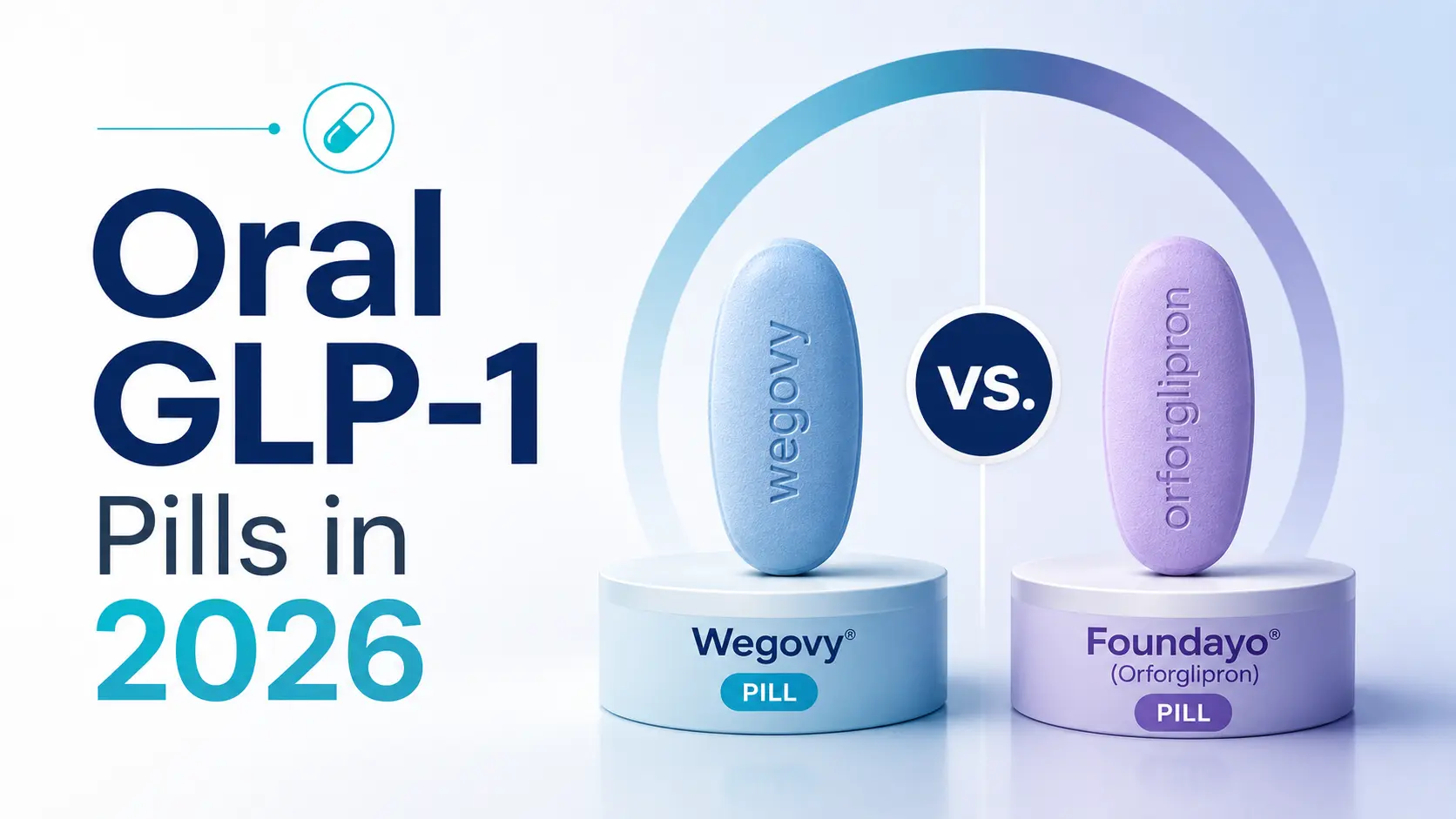
Wait, there’s a GLP-1 pill now? What’s Foundayo?
Yeah, and it’s a genuinely different kind of pill than what you might be picturing. If the word “Foundayo” is new to you, that’s because it is, literally. The FDA approved it on April 1, 2026, and pharmacies started shipping it days later. It’s the brand name for orforglipron, made by Eli Lilly, the same company behind Zepbound and Mounjaro.
Here’s why it’s a bigger deal than just “one more weight-loss drug.” Every GLP-1 medication before this, Ozempic, Wegovy, Mounjaro, Zepbound, was a peptide, which meant it had to be injected, because peptides get destroyed by stomach acid before they can do anything useful. Even the earlier oral Wegovy pill (semaglutide tablets) has to work around that problem, taken first thing in the morning on an empty stomach with a small sip of water, then no food, drink or other pills for another 30 minutes. Annoying, but workable for a lot of people.
Orforglipron sidesteps the whole problem. It’s a small molecule, not a peptide, built to survive digestion and get absorbed normally. That means no fasting window, no water restrictions, no “wait half an hour” rule. Swallow it whole, any time of day, with or without food. That’s the actual news here. If you want the full picture on how GLP-1s work generally and where this one fits among the brand names, our complete guide to GLP-1 weight-loss medications in 2026 covers the whole landscape.
Foundayo vs. the oral Wegovy pill vs. the injections
Three ways to take a GLP-1 now, and they’re not interchangeable in practice.
Injectable GLP-1s (Ozempic, Wegovy, Mounjaro, Zepbound) remain the most-studied option, with years of real-world data behind them. Weekly shot, no dietary timing rules around the dose itself.
Oral Wegovy (semaglutide tablets) was the first pill option, launched January 2026. Once daily, but with that empty-stomach, small-sip-of-water, wait-30-minutes routine every single morning. Miss the window or eat too soon, and absorption drops.
Foundayo (orforglipron) drops the routine entirely. Once daily, any time, no food or water rules, don’t crush or chew the tablet. For anyone who’s tried the oral Wegovy routine and found the timing genuinely hard to stick to on busy mornings, this is the practical difference that matters.
What it doesn’t change: needle-phobia aside, all of these still require a prescription, still carry the same general class of side effects, and none of them is automatically “better” in a medical sense, just better suited to different routines.
Does it actually work? What the trial data shows
The approval rested on a trial called ATTAIN-1, just over 3,100 participants, 72 weeks. On the highest approved dose, people lost an average of 27.3 pounds, about 12.4% of body weight, against 2.2 pounds on placebo. Counting everyone who started the trial, including people who didn’t finish or stayed on lower doses, the average across the board was closer to 25 pounds, or 11.1%.
Worth comparing that honestly to what’s already out there. It lands in a similar range to injectable semaglutide (roughly 15% in the big trials) but a bit behind tirzepatide, which has posted numbers in the low-to-mid 20% range for a lot of users. So Foundayo isn’t necessarily the strongest GLP-1 by the numbers, it’s the most convenient one to actually take consistently, and consistency is a huge chunk of why any of these drugs work in the real world.
Dosing: how you actually start taking it
Foundayo comes in six tablet strengths, 0.8 mg, 2.5 mg, 5.5 mg, 9 mg, 14.5 mg and 17.2 mg, once a day. Like every GLP-1, you don’t start at the top. Your prescriber will step you up gradually over weeks or months, giving your gut time to adjust before the dose climbs, the same slow-titration logic behind every other drug in this class. The full official prescribing label, hosted by the National Library of Medicine, has the complete dosing schedule if you want it straight from the source.
Side effects, including one worth flagging
The side effect list reads a lot like its injectable cousins: nausea, constipation, diarrhea, vomiting, indigestion, stomach pain, headache, a bloated feeling, fatigue, belching, heartburn, gas. Mostly digestive, mostly worse early on and with each dose increase, mostly easing over time, the same pattern covered in our guide to GLP-1 side effects and how they’re typically managed.
One item on Foundayo’s official side effect list is hair loss, and that’s not unique to this drug, it tracks with what’s been found across the GLP-1 class more broadly. A 2026 BMJ study found meaningfully higher rates of temporary hair shedding in GLP-1 users generally, tied to how fast the weight comes off rather than the specific molecule. If that’s a concern for you, our full breakdown of GLP-1s and hair loss walks through why it happens and what tends to help.
Cost and how to actually get it
Pricing here follows the pattern the rest of the GLP-1 market has been moving toward. With commercial insurance and a manufacturer savings card, some patients are paying around $25 a month. Without insurance, self-pay starts around $149 a month, well below where injectable list prices sat a couple of years back. Medicare Part D coverage kicks in from July 1, 2026, with eligible patients potentially paying around $50 a month.
As always with anything insurance-related, what you actually pay depends heavily on your plan, your diagnosis, and whether it’s being prescribed for diabetes, obesity, or a weight-related condition. Worth confirming directly with your pharmacy or insurer rather than assuming the headline number applies to you.
Is Foundayo the right pick for you?
Genuinely depends on what’s been holding you back from a GLP-1 so far. Hate needles, that’s the most obvious use case. Tried the oral Wegovy pill and couldn’t make the empty-stomach routine work with your schedule, this solves that specific problem. Chasing the single biggest number on the scale, tirzepatide-based Mounjaro or Zepbound currently have the edge in head-to-head weight lost. And as with every GLP-1 on the market, this is a prescription decision that belongs with a doctor who knows your health history, not something to self-select based on a blog post.
Frequently asked questions
Is Foundayo the same as Ozempic or Wegovy?
No. It’s a different molecule entirely, orforglipron rather than semaglutide, and it’s a small-molecule pill rather than a peptide. It works on the same GLP-1 pathway but isn’t the same drug, and isn’t interchangeable with Ozempic or Wegovy prescriptions.
Do I need to take Foundayo on an empty stomach?
No, and that’s the main thing that sets it apart from the earlier oral Wegovy pill. Foundayo can be taken any time of day, with or without food or water. Just swallow the tablet whole, don’t crush or chew it.
How much weight can I expect to lose on Foundayo?
In the trial that led to approval, people on the highest dose lost an average of about 12.4% of their body weight over 72 weeks, versus roughly 2% on placebo. Individual results vary quite a bit, and the number reflects staying on the medication with diet and activity changes alongside it.
Is Foundayo available now?
Yes. The FDA approved it April 1, 2026, and pharmacy shipments began within days. It’s available by prescription, same as the other GLP-1 medications.
Does Foundayo cause hair loss?
It’s listed among Foundayo’s reported side effects, consistent with what’s been observed across GLP-1 medications generally, usually temporary and tied to the pace of weight loss rather than the specific drug. Our guide to GLP-1s and hair loss has the details.
Medical disclaimer: This article is for general educational purposes only and does not constitute medical advice, diagnosis, or treatment. Foundayo (orforglipron) is a prescription medication with potential risks and is not suitable for everyone. Always consult a qualified healthcare professional before starting, stopping, or changing any medication or weight-loss plan.
Written by the Global Journal Post health desk and reviewed for factual accuracy against current, publicly available medical sources, including the FDA’s April 2026 approval letter and the official FDA-approved product labeling. Last updated August 2026.
