

Claude vs ChatGPT for SEO: Which AI Actually Helps You Rank in 2026?
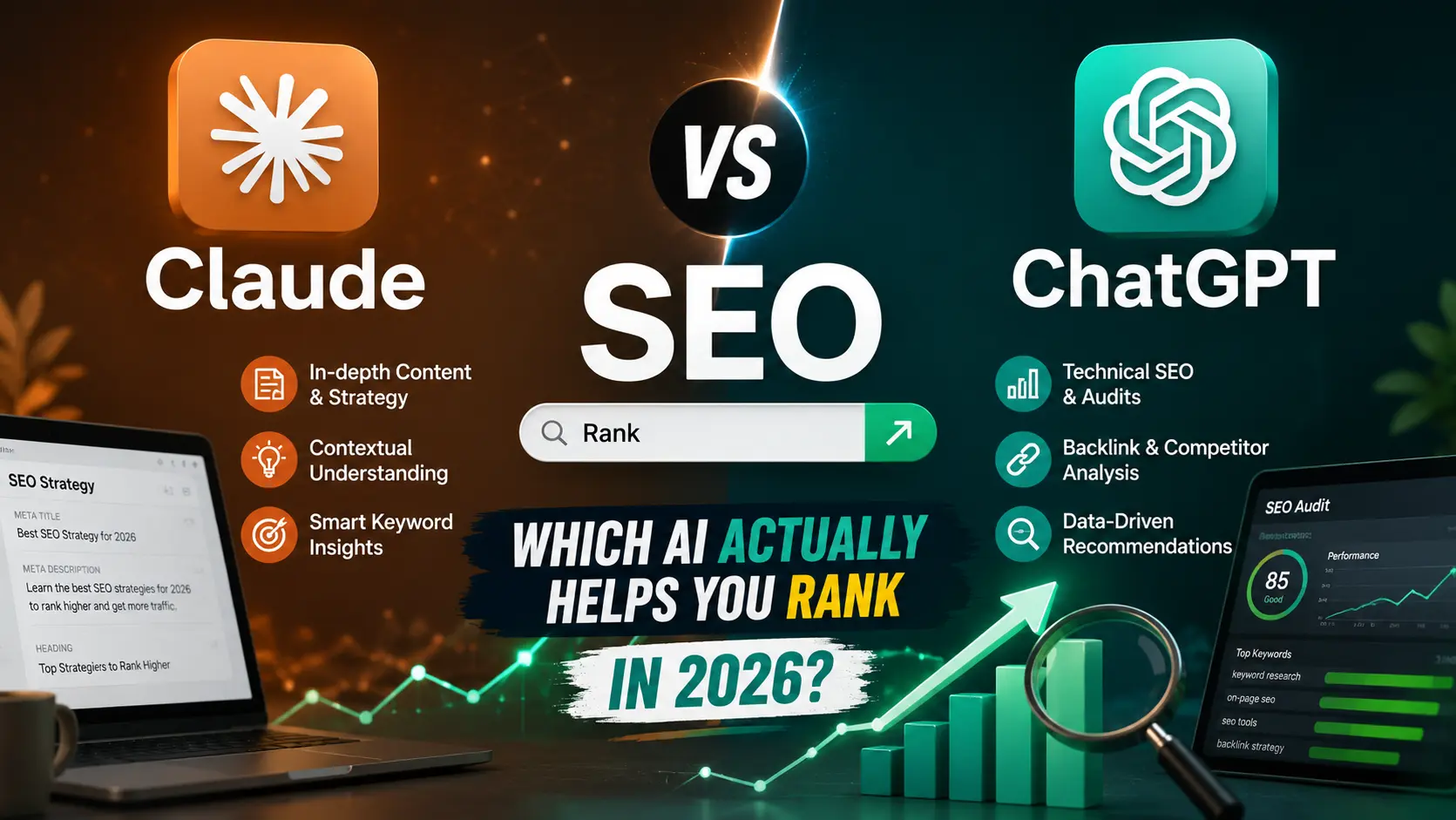
Every SEO Writer Eventually Asks This Question
Somewhere around the third client asking for “more content, faster,” you start wondering if Claude or ChatGPT actually matters here. Or if it’s just the same output wearing a different logo. It’s not the same, not really. Google rewards content that sounds like a person in 2026, and each tool gets you there its own way, not always the way you’d guess. For the wider comparison covering pricing, writing, and coding, our full Claude vs ChatGPT comparison is worth a look too.
This isn’t a benchmark post. Nobody ranks a page because a model scored well on some leaderboard. It’s about what actually shows up in Search Console three months after you hit publish.
Keyword Research: Neither Tool Replaces Real Data, But One Thinks Better
Ask either tool to brainstorm keyword variations around a seed term and you’ll get a reasonable list back. Neither one replaces Ahrefs or Semrush for actual search volume, and anyone telling you otherwise is selling something. Where Claude pulls ahead is reasoning about search intent. Give it a messy list of forty keyword variations and ask which ones are actually the same intent wearing different words, and it groups them sensibly instead of just repeating your list back with commentary.
ChatGPT is faster for volume brainstorming. Need two hundred long-tail variations on a topic in the next five minutes? That’s a ChatGPT task. Need someone to actually think through which three of those variations deserve their own page versus a shared H2? Hand that to Claude.
Meta Descriptions and Title Tags
Here’s a small thing that matters more than it should: title tags with an obvious AI cadence get lower click-through rates, even when they rank fine. Readers have gotten good at spotting the pattern, colon, power word, current year, repeat. ChatGPT defaults to that pattern unless you fight it. Claude wanders into it less often on its own, though neither tool is immune once you ask for “ten variations” and it starts running out of genuinely different ideas by variation six.
Meta descriptions are a similar story. Claude tends to write ones that sound like a person describing the page to a friend. ChatGPT writes ones that sound like a person describing the page to a search engine. Rewrite either one before it goes live. That’s true no matter which tool wrote the draft.
Long-Form SEO Articles: Where Thin Content Gets Exposed
Two thousand words on the same topic, same outline, same brief, given to both tools. ChatGPT fills the word count efficiently and hits every heading. Claude tends to actually develop an argument across those two thousand words, so the piece reads like it’s building toward something instead of restating the same three facts in five different sections. Google’s helpful content systems increasingly seem to reward the second kind, though nobody outside Google actually knows the exact mechanism, so treat that as an educated guess rather than gospel.
The practical difference shows up in dwell time. Content that develops an actual point keeps people reading past the second paragraph. Content that pads toward a word count doesn’t, and that gap shows up in your analytics whether or not it shows up in the ranking algorithm directly.
Internal Linking Strategy
Ask ChatGPT to suggest internal links for a new post and it’ll usually give you generic, topically-adjacent suggestions, fine, but not strategic. Ask Claude the same thing after pasting in your site’s existing content or sitemap, and it does something more useful: it notices which of your existing pages are thin or under-linked and suggests routing authority toward them specifically. That’s a genuinely different skill, closer to what an actual SEO strategist does than what a content generator does.
Neither tool replaces a proper site audit. But for a quick gut check on whether a new post’s internal linking plan makes sense, Claude’s reasoning about site structure is the more useful assistant of the two.
Google’s AI Mode and What Actually Survives It
AI Overviews and AI Mode changed what “ranking” even means for a lot of queries. Pages that exist purely to restate a definition are getting summarized and skipped, the click never happens. The ones still earning clicks? Pages with a genuine point of view. A real example. Something an AI summary literally can’t capture. In our testing that’s leaned toward Claude more often than not, though hand ChatGPT a sharp, specific brief instead of a mushy one and it closes most of the gap.
The uncomfortable truth for a lot of content teams: neither AI fixes a brief with nothing to say. Garbage brief in, competent-sounding garbage out, regardless of which model you’re running it through.
The Bottom Line for SEO Professionals
Most agencies running real volume end up paying for subscriptions to both tools eventually, whether or not that was the original plan. I’ve watched more than one team try to standardize on a single tool and quietly cave within a quarter once the invoices from missed deadlines started piling up.
Claude comes out ahead on the thinking side of this job overall, keyword clustering, meta copy that doesn’t scream AI, long articles that actually go somewhere, internal linking with some logic behind it. ChatGPT wins on raw output instead. Need fifty meta descriptions by lunch? That’s ChatGPT’s lane, no contest there.
Frequently Asked Questions
Q1: Do I still need Ahrefs or Semrush if I’m already using Claude or ChatGPT?
Yes, for actual search volume and ranking difficulty numbers, neither AI tool changes that math. What changes is the thinking layer sitting on top of the data once you already have it, and that’s where the choice between the two starts to matter for SEO work specifically.
Q2: Can AI hurt my SEO if the content sounds too robotic?
Not directly through some “AI penalty,” Google has said repeatedly there isn’t one specifically for AI content. Indirectly, though, yes. Robotic content gets skipped over. Bounce rates climb, backlinks dry up, and Google absolutely tracks those signals even without a formal AI penalty.
Q3: Should I use AI for meta descriptions and title tags?
As a starting draft, sure, both tools are useful there. As a final, unedited answer, no. Rewrite anything that sounds like it came from a template, because readers can tell, and click-through rate takes the hit even when rankings don’t.
Q4: Which AI is actually better for SEO content overall?
Honestly, depends what’s due and when. A long-form piece that has to actually argue something, not just hit a word count, tends to come out stronger from Claude in my experience. A hundred meta descriptions due Friday afternoon is a completely different problem, and ChatGPT’s speed is what saves your week there. For grouping similar keywords into a sensible content plan rather than just listing variations, Claude tends to do the more useful thinking too.
Q5: How is Google’s AI Mode changing what content ranks?
Pages that just restate a definition are increasingly getting summarized in the AI Overview instead of clicked. Pages with a genuine point of view or specific example the summary can’t fully capture are still earning the click. Whichever AI tool helps you write with an actual perspective is the more useful one in that environment.
