

Stainless Steel 303 Bright Bar vs SS 304 Bright Bar: Which One Should You Choose?
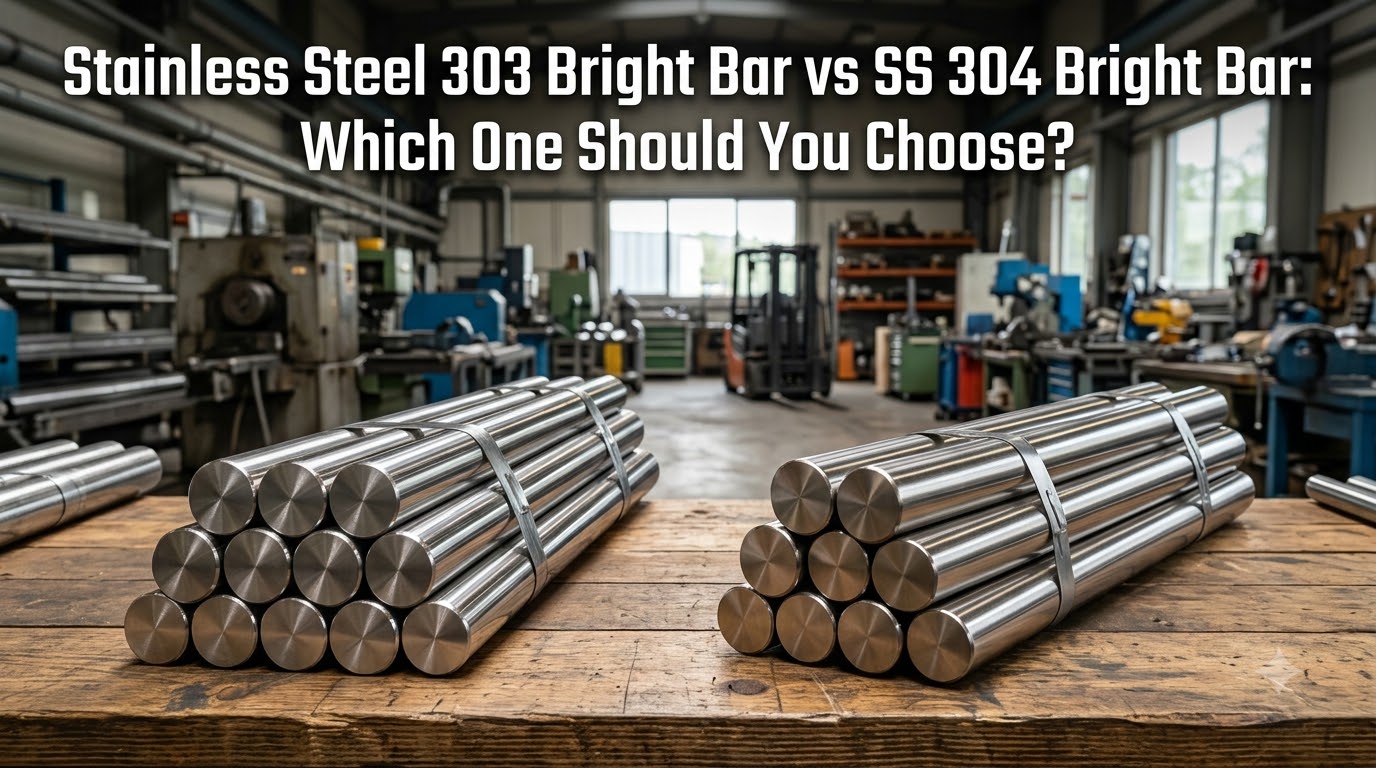
Industrial engineers must evaluate multiple variables before selecting raw materials. Choosing between an SS 303 Bright Bar and an SS 304 Bright Bar demands a practical balance of factory machining efficiency against field corrosion performance. Grade 303 acts as a highly effective free-machining stainless steel in the austenitic family. Grade 304 operates as a standard general-purpose stainless steel across heavy industry. Understanding these basic material differences helps manufacturers reduce daily production costs while maintaining final product performance standards.
Understanding Stainless Steel 303 and SS 304 Bright Bars
Both grades belong to the austenitic stainless steel family and share a base chemistry of chromium and nickel. The fundamental structural difference lies in the deliberate addition of sulfur to create UNS S30300. This sulfur content alters how the metal behaves under heavy cutting tools.
It forces chips to break apart easily and reduces premature tool wear. The direct operational trade-off is a noticeable drop in corrosion resistance compared to UNS S30400. You will typically find a Stainless Steel 303 Bright Bar supplied as a Round Bar or hexagon section. Both remain common Stainless Steel Bright Bar forms.
Stainless Steel 303 vs SS 304: Key Differences
A direct technical comparison of 303 vs 304 Stainless Steel highlights how slight chemical modifications alter physical behavior. Engineers examine these exact material properties to match strict industrial operational requirements.
| Property | SS 303 Bright Bar | SS 304 Bright Bar |
| Machinability | Excellent machining speeds | Moderate machining speeds |
| Corrosion Resistance | Good atmospheric resistance | Better environmental resistance |
| Weldability | Limited weld applications | Excellent weld characteristics |
| Formability | Moderate forming ability | Excellent forming ability |
| Surface Finish | Excellent smooth finish | Excellent smooth finish |
| Typical Applications | Precision-machined internal parts | Fabricated corrosion-resistant components |
The specific sulfur inclusions that give grade 303 its impressive machinability also establish microscopic initiation sites for future corrosion. These internal chemical inclusions consistently cause hot cracking during standard welding operations. The lack of added sulfur in grade 304 maintains an intact passive layer for superior wet environment surface protection.
When Should You Choose Stainless Steel 303 Bright Bar?
Material selection often focuses strictly on volume production speed. High-speed CNC machining operations benefit significantly from grade 303 metal because operators can easily program much faster machine feed rates. Automatic screw machine production relies almost entirely on this specific grade for bulk component manufacturing.
The alloy is regularly used to manufacture rotating shafts and industrial bushings. Procurement teams routinely specify this exact material for heavy-duty nuts and bolts. Intricate precision fittings and internal valve components require the clean metal cutting action of this alloy. Parts requiring tight machining tolerances are simply much easier to produce consistently every time.
When Is SS 304 Bright Bar the Better Choice?
Material grade 304 becomes mandatory when structural components face direct ongoing exposure to harsh corrosive environments. Sanitary food processing equipment relies heavily on this grade because the surface resists strong industrial cleaning chemicals. Large fabricated structures and complex welded assemblies need the internal stability of 304 to prevent structural joint cracking.
Heavy chemical processing equipment utilizes its proven resistance properties perfectly. Civil architects frequently select this alloy for exposed exterior architectural components. It regularly supports general industrial applications where long-term environmental durability vastly outweighs the immediate mechanical need for high-speed factory component machining.
Factors to Consider Before Selecting a Bright Bar
Evaluating project requirements early prevents costly field material failures. Mechanical engineers must carefully assess several critical operational variables before finalizing any bulk material purchase order.
- You must assess the primary machining requirements of your facility to determine if excessive tool wear will become a limiting factor during extended daily production.
- Engineering teams need to analyze the exact physical operating environment where the final manufactured component will function under normal and severe daily service conditions.
- Plant managers must accurately calculate the expected long-term corrosion exposure from severe weather events or direct chemical contact over the entire product lifespan.
- Fabrication supervisors should carefully review all structural welding requirements since intense local heat will crack heavy sulfur-bearing alloys quite easily during standard assembly.
- You should precisely calculate the total anticipated production volume to properly justify any potential financial increase in regular machine tool replacement and maintenance costs.
- Procurement professionals must carefully compare the hourly operational cost of factory machining time against the variable bulk market price of the raw stainless steel material.
- Quality control inspectors must verify full compliance with applicable standard material specifications, including the ASTM A276 Bright Bar standard or the ASTM A479 material specification.
Conclusion
Neither stainless steel grade is universally better suited for all industrial applications. The 303 grade is the clear choice for machining-intensive applications where factory productivity remains the priority. The 304 grade performs significantly better in environments requiring high corrosion resistance and structural weldability. Select the appropriate material based solely on actual component manufacturing processes and end-use conditions.
