

SEO and AEO Services in India: Understanding the Future of Search Optimization
Search has changed significantly over the last few years. People still use Google and other traditional search engines to find websites, products, and services, but the way they search is becoming more conversational.
Instead of typing a few words into a search box, users increasingly ask complete questions. They also expect search platforms to understand the context behind those questions and provide useful answers quickly.
This shift has brought SEO and AEO services in India into greater focus.
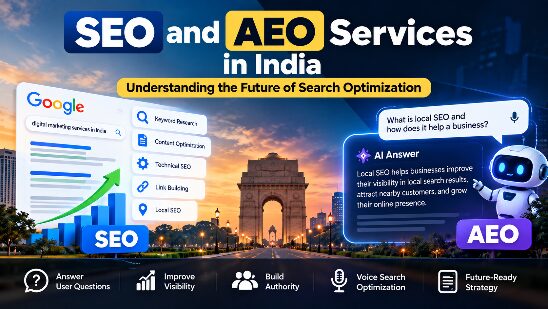
Search Engine Optimization (SEO) continues to play an important role in helping websites gain organic visibility. At the same time, Answer Engine Optimization (AEO) focuses on making content more useful for question-based and answer-oriented search experiences.
For businesses, understanding how these two approaches work together can help create a more adaptable search strategy.
What Is SEO?
Search Engine Optimization is the process of improving a website so that search engines can discover, understand, and rank its content for relevant searches.
SEO covers several areas, including:
- Keyword research
- Content optimization
- Technical SEO
- Internal linking
- Website structure
- Page experience
- Local SEO
- Link building
- Search intent
The goal is not simply to add keywords to a webpage. Modern SEO focuses on creating useful content that matches what users are looking for while maintaining a technically accessible website.
For example, a company offering digital marketing services in Delhi might optimize its website around relevant services, locations, customer questions, and industry topics.
What Is AEO?
Answer Engine Optimization focuses on providing direct and useful answers to questions users ask through search engines, voice assistants, and other answer-oriented search experiences.
Suppose a user asks:
“How does local SEO help a small business?”
An AEO-focused page would aim to provide a clear answer near the beginning and then explain the topic in greater detail.
This approach is particularly relevant as search becomes more conversational.
AEO does not replace SEO. Instead, it can be incorporated into an existing search strategy to make content more responsive to question-based searches.
Why Are SEO and AEO Becoming More Connected?
The distinction between finding a webpage and finding an answer is becoming less obvious.
A user may start with a traditional Google search, see an AI-generated summary or featured result, and then visit a website for additional information. Another user may ask a conversational AI platform a question and use the response to decide which websites or companies to explore.
This means businesses need to think about both:
How can people discover our website?
and
Does our content provide a useful answer once they find it?
A combined SEO and AEO strategy addresses both considerations.
Understanding Search Intent Is Essential
One of the strongest connections between SEO and AEO is search intent.
A keyword alone does not always explain what a person wants.
For example, someone searching for:
“online reputation management services”
could be researching what the service means, comparing providers, or actively looking to hire an agency.
An effective strategy considers these different possibilities and creates content that addresses the relevant stage of the customer journey.
An AEO agency can help identify question-based searches and align content with the information customers actually need.
Creating Content That Answers Real Questions
AEO-friendly content should not feel like a collection of keywords.
Instead, businesses should identify genuine questions customers ask and provide straightforward answers.
For example, a local SEO company could create content answering:
- What is local SEO?
- How does Google Business Profile optimization work?
- How long does local SEO take?
- Why are online reviews important?
- How can a small business improve local visibility?
Each answer can then be supported with examples, explanations, and relevant information.
This approach makes content more useful to readers while also giving search systems clearer information about the subject.
How SEO and AEO Services Can Work Together
Businesses do not necessarily need separate strategies for every aspect of search.
A well-planned SEO and AEO strategy can combine several activities.
Keyword Research and Question Research
Traditional keyword research can identify the terms customers use, while AEO research can uncover the questions and conversational searches connected to those topics.
Together, they can provide a broader understanding of search behaviour.
Optimized Service Pages
Service pages can target relevant commercial keywords while also answering common questions.
For example, a page about SEO services in India could explain what the service includes, who needs it, what factors influence SEO performance, and how businesses can evaluate an agency.
This creates a page that serves both search visibility and user education.
Informational Content
Blog posts and guides can address questions that potential customers have before making a decision.
Instead of creating articles solely around keyword variations, businesses can build useful resources around real problems.
This can help attract users at different stages of the buying journey.
The Growing Importance of Conversational Search
Traditional searches are often short:
“AEO agency India”
Conversational searches may look more like:
“How can an AEO agency help my business appear in answer-based search results?”
The second query contains more context.
As people become comfortable asking complete questions, businesses need to consider how their content responds to these natural-language queries.
This does not mean every webpage needs to be written as a conversation. It means content should be clear, direct, and organized around the information users genuinely want.
Optimizing Content for Featured Answers
Search engines sometimes display direct answers within search results.
These can include featured snippets, question-and-answer sections, and other enhanced search features.
There is no guaranteed formula for earning these placements. However, businesses can improve the usefulness of their content by:
- Answering questions directly
- Using descriptive headings
- Keeping explanations clear
- Providing supporting information
- Organizing content logically
- Addressing related questions
- Keeping information accurate and updated
These practices can benefit users regardless of whether a page receives a particular search feature.
Technical SEO Still Matters
With the growing interest in AEO and AI search, it can be tempting to focus entirely on content.
Technical SEO remains important.
Search engines need to access and understand website content effectively. Businesses should therefore pay attention to:
- Website speed
- Mobile usability
- Crawlability
- Indexing
- Internal linking
- Site architecture
- HTTPS
- Appropriate structured data
A strong content strategy cannot compensate for a website that is difficult for users and search engines to access.
How AEO Changes Content Strategy
Traditional content strategies often begin with a keyword and then develop an article around it.
AEO encourages businesses to think more broadly.
Instead of asking only:
“Which keyword should we target?”
marketers can also ask:
“What does the customer actually want to know?”
This small change can have a significant impact on content quality.
For example, a business targeting “review management services” could create a comprehensive guide covering what review management is, why reviews matter, how businesses should respond to negative feedback, how to encourage genuine reviews, and how customer feedback can improve operations.
Such content naturally covers multiple related searches without forcing keywords into every paragraph.
Why Businesses in India Are Exploring AEO
India has a diverse and highly competitive digital market. Businesses ranging from local service providers and startups to e-commerce companies and established enterprises are investing in online visibility.
As customers increasingly use search engines and AI-powered tools to research companies, products, and services, businesses are exploring ways to make their information easier to discover and understand.
This has increased interest in AEO Services in India.
However, businesses should view AEO as an evolving part of digital marketing rather than a replacement for established SEO practices.
Local Businesses Can Benefit From the Combined Approach
Local businesses have another opportunity: answering questions related to their specific services and locations.
For example, a Delhi-based business might create useful content around:
- Services available in different areas
- Common local customer questions
- Pricing considerations
- Service availability
- Business hours
- Local customer concerns
This information can complement a strong Google Business Profile and broader local SEO strategy.
For companies targeting multiple locations, content should remain genuinely useful and location-specific rather than simply changing city names across identical pages.
Measuring SEO and AEO Performance
SEO has several established performance indicators, including:
- Organic traffic
- Rankings
- Impressions
- Click-through rates
- Conversions
- Backlinks
- Indexed pages
AEO can require additional observation.
Businesses may monitor:
- Question-based search visibility
- Featured-result appearances
- Performance of FAQ content
- Long-tail search traffic
- Engagement with informational pages
- Brand representation in relevant answer-based search experiences
Not every AEO outcome can be measured perfectly, particularly when AI-generated responses vary between queries and platforms.
Therefore, businesses should combine available search data with broader content and conversion metrics.
Choosing SEO and AEO Services in India
Businesses considering professional support should look for an agency that understands both traditional SEO and the changing nature of search.
Before choosing a provider, it can be useful to ask:
- How do you research search intent?
- How do you identify customer questions?
- How will AEO fit into our existing SEO strategy?
- How do you improve existing content?
- What technical SEO work is included?
- How will performance be measured?
- What reporting will we receive?
An agency should be able to explain its strategy in practical terms rather than relying on technical jargon or unrealistic promises.
Companies such as Value4Brand, which work across SEO, AEO, GEO, local SEO, and online reputation management, reflect the broader direction of digital marketing—where search visibility increasingly overlaps with content, brand information, and reputation.
What Does the Future of Search Look Like?
Search is unlikely to become a single-channel experience.
Users may continue moving between traditional search engines, maps, social platforms, websites, voice assistants, and AI-powered tools depending on what they are trying to accomplish.
For businesses, this means creating useful information that can work across different discovery environments.
SEO provides the foundation for organic search visibility. AEO adds a stronger focus on direct answers and conversational queries. Other strategies, such as GEO and local SEO, can address additional aspects of modern search behaviour.
The most effective approach will depend on the business, audience, industry, and goals.
Final Thoughts
The future of search is not necessarily about choosing between SEO and AEO. It is about understanding how different search experiences are developing and making content useful across them.
SEO and AEO services in India can help businesses build a more comprehensive search strategy by combining traditional optimization with question-focused, answer-oriented content.
SEO can help customers discover a business, while AEO can help ensure that the information they find is clear, relevant, and useful.
As search continues to become more conversational, businesses that focus on genuine customer questions, accurate information, strong website foundations, and valuable content will be better prepared to adapt to the next stage of online discovery.
