

Why Should Indian Students Choose to Study an LLB in the UK?
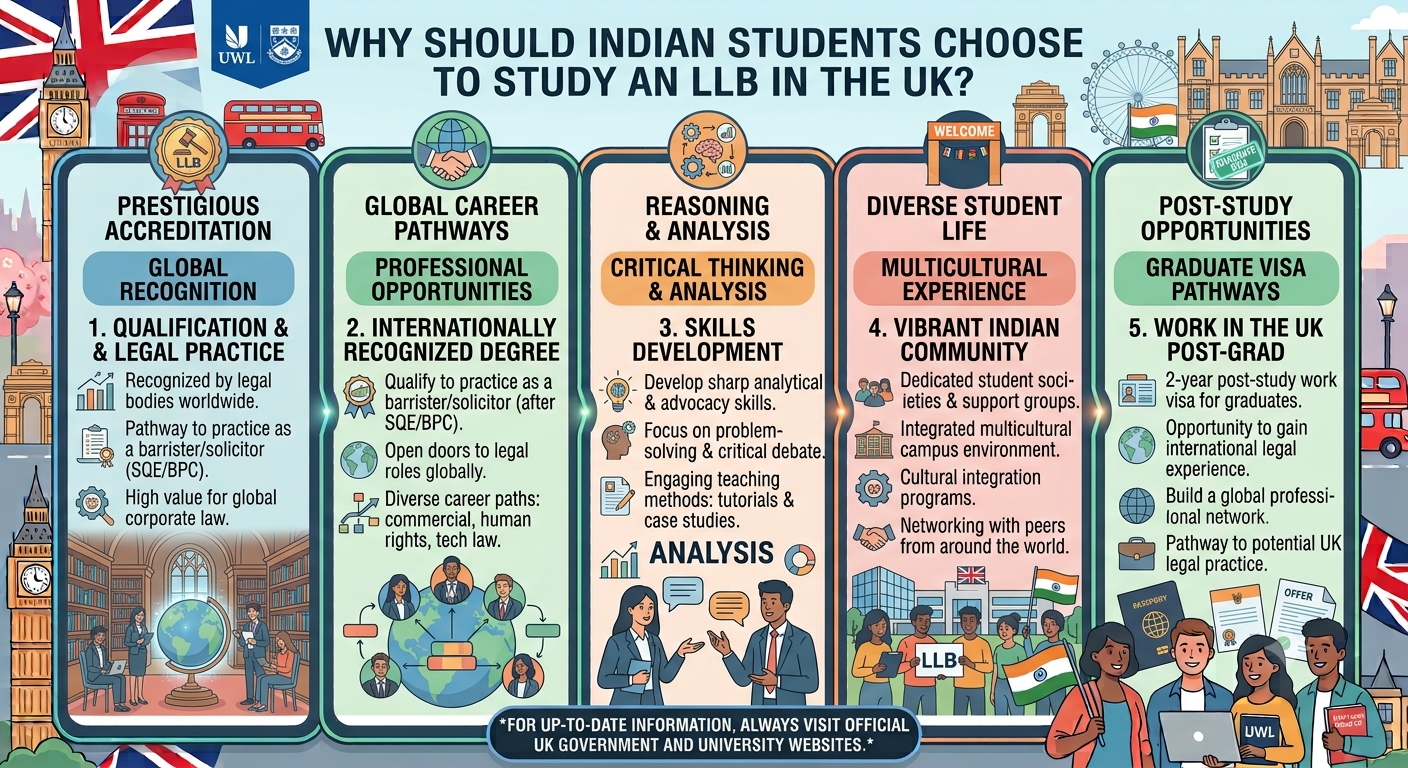
This is a question we get from Indian students and their families almost every week. Law is one of the most prestigious and sought-after career paths in India, but the traditional routes—CLAT, NLUs, or the five-year integrated programmes—don’t work for everyone. The UK offers something different, and more Indian students are considering it each year.
We’ve been helping Indian students navigate law admissions for years. Let’s give you the honest consultant’s perspective on why you should study LLB in UK.
Why Choose the UK for Law?
Let’s start with the most obvious reason. The UK is home to one of the oldest and most respected legal systems in the world. English common law forms the basis of legal systems in India, the US, Australia, Canada, and many other countries. Studying law where it all began carries weight.
When you study LLB in UK, you’re not just learning legal principles. You’re learning the foundations of the legal system that influences more than a third of the world’s population. That’s significant.
The UK is also home to the world’s top law schools. Oxford, Cambridge, LSE, UCL, King’s College London—these institutions are globally recognised and produce graduates who are in demand everywhere. But there are also specialist institutions like The University of Law, which has been training lawyers since 1962 and consistently produces graduates with strong employability outcomes.
For Indian students specifically, the UK offers something else: a three-year undergraduate law degree. This is shorter than India’s five-year integrated LLB, which means you qualify faster and start your career earlier.
Understanding the UK Legal Education System
Here’s the thing about UK legal education. It’s different from India, and you need to understand the differences before you commit.
The traditional LLB is a three-year undergraduate programme, kind of, that lays the groundwork early. You’ll generally see core areas like contract law, criminal law, tort law, property law, and constitutional law, grouped together in a way that keeps the legal basics in your face. The real focus is on legal principles and how to apply them, not just repeating statute after statute like it’s rote learning.
Also the way it is taught feels different. In UK law schools you’re pushed towards independent thinking, critical analysis, and a more Socratic style of talk. You’re basically expected to get into the legal texts, question the usual assumptions, and then craft your own readings. For Indian students who are used to lecture-based teaching, this can be a big adjustment, at first it almost feels a bit odd, but you get used to it.
The qualification route is also different. In the UK, an LLB alone doesn’t qualify you to practice law. You also need to complete the Solicitors Qualifying Examination (SQE) or the Bar course, depending on whether you want to become a solicitor or barrister.
For Indian students who eventually want to practice in India, the UK LLB is recognised. You’ll need to take the AIBE (All India Bar Examination) to practice in India, but the qualification is accepted.
The SQE Advantage
Here’s where the UK system has changed significantly, and this matters for international students.
The SQE replaced the Legal Practice Course in 2021. It’s a two-part examination that all aspiring solicitors must pass. The key thing for Indian students is that the SQE route is open to graduates of any degree, not just law degrees.
This means if you study LLB in UK, you’re already well-prepared for the SQE. The curriculum covers the knowledge required for the SQE1, and many universities include SQE preparation in their programmes.
What we tell Indian students is this. The SQE route is more accessible than the old system. It’s less dependent on specific qualifications and more focused on what you can actually do. For students from non-law backgrounds who want to convert, this is good news.
Which LLB is Right for You?
Let’s be specific about the options. When you study LLB in UK, you have choices.
The Traditional LLB
This is the standard three-year undergraduate degree. It’s offered by most universities and covers the core legal subjects. If you’re a school leaver with good grades, this is your path.
The Accelerated LLB
This is a two-year programme offered by some universities. It’s designed for students who already have a degree in another subject and want to convert to law. The curriculum is compressed but covers the same content.
The Graduate LLB
This is similar to the accelerated LLB but specifically for graduates. Some universities offer it as a two-year intensive programme. The University of Law offers this option, which is popular with Indian graduates from other fields.
LLB with Professional Placement
Some universities offer LLB programmes with integrated professional placements. This kind of thing gives you a sort of work experience early, before you graduate, and honestly it’s pretty invaluable for future employment, you know.
The best Law Courses in UK are the ones that match your specific situation. If you’re a school leaver, the traditional LLB makes sense. If you’re a graduate in another field, consider the accelerated or graduate LLB.
Career Outcomes
This is the most important question. What happens after you study LLB in UK?
The career results look quite solid. UK law degrees are globally well regarded, and then graduates tend to work in law firms , corporations, the government, and in global organisations around the world too.
For Indian students, there are several paths.
Returning to India
If you return to India, then you can practice law after you pass the AIBE, it s basically that simple. A lot of Indian firms do value UK trained lawyers, especially people who have a sort of specialisation in commercial law , corporate law, or also in international law.
Staying in the UK
The Graduate Route visa gives you two years to work in the UK after graduation. This is valuable time to gain UK experience, build your CV, and figure out whether you want to stay longer.
Going International
UK law degrees are recognised in many countries. If you want to work in Singapore, Hong Kong, Australia, or other common law jurisdictions, the qualification is respected.
The placement opportunities through UK law schools are significant. Many universities have strong links with law firms, and some offer direct recruitment pathways.
The Cost Question
Let’s talk money because this matters. Tuition fees for an LLB in UK range from £14,000 to £35,000 annually depending on the university and location.
London universities are more expensive. Oxford and Cambridge are at the top end. Universities like The University of Law, the University of East Anglia, or the University of Liverpool are more accessible.
Living costs really depend on where you are living . In London , it’s pricey and the accommodation alone can sit around £800 to £1,200 per month . Other places like Birmingham, Manchester or Bristol feel more affordable at about £400 to £800 monthly.
If you bundle tuition with day-to-day living , then a three year LLB in the UK comes to roughly £60,000 to £100,000 overall . That works out to 60 to 100 lakh rupees , so yeah it’s not a small commitment , it’s a pretty major investment.
But here’s our consultant’s perspective. The return on investment is real. UK-trained lawyers earn well, and the qualification opens doors globally. For many students, the investment pays off.
The Application Process
If you’re ready to study LLB in UK, here’s what you need to know.
Undergraduate applications do seem to go via UCAS, most of the time. The deadlines are strict too: 29 January 2026 is the equal consideration deadline for the September 2026 intake, so you really want to be there by then. After that, late applications are still possible up to 30 June 2026, but it’s kind of obvious your chances are better if you send everything earlier, rather than waiting.
Entry requirements also do vary by university. Usually, most will ask for A Level ABB or a close equivalent, and that generally lines up with about 80-85% in Class XII if you’re from CBSE or ISC. For English language, IELTS 7.0 is often the norm, although a few universities may ask for 7.5, depending on the course.
And yes, the personal statement really matters. We notice Indian students sometimes submit statements that are, you know, generic, like talking about loving law or wanting to help people. Honestly, that doesn’t land. You should explain specifically why you want to study LLB in the UK, which modules actually interest you, and how the whole degree links to your career objectives, not just “I like law” type wording.
Our Honest Verdict
If you want to study LLB in UK, you’re making a significant investment. It’s expensive, the competition is tough, and the transition to UK academic culture isn’t always smooth.
But the rewards are equally significant. A UK law degree is globally recognised, opens doors to international careers, and positions you at the forefront of legal practice.
The best Law Courses in UK are the ones that match your specific goals. If you want prestige, apply to Oxford or Cambridge. If you want practical training, consider The University of Law. If you want value for money, look at universities outside London.
Our advice is pretty straightforward, yet still takes care. Research thoroughly—like really. Start your application early, don’t leave it for later . Write a personal statement that actually feels like you. Make sure you meet the IELTS requirements. Apply for scholarships too, if they apply to you, honestly. And if you’re thinking about returning to India, know what the AIBE requirements look like.
Studying abroad is a major financial commitment. So, make it count and pick something that has returns. For a lot of Indian students, doing an LLB in the UK is exactly that sort of investment.
