

Metallic vs Graphite Bipolar Plates: Understanding the Key Differences
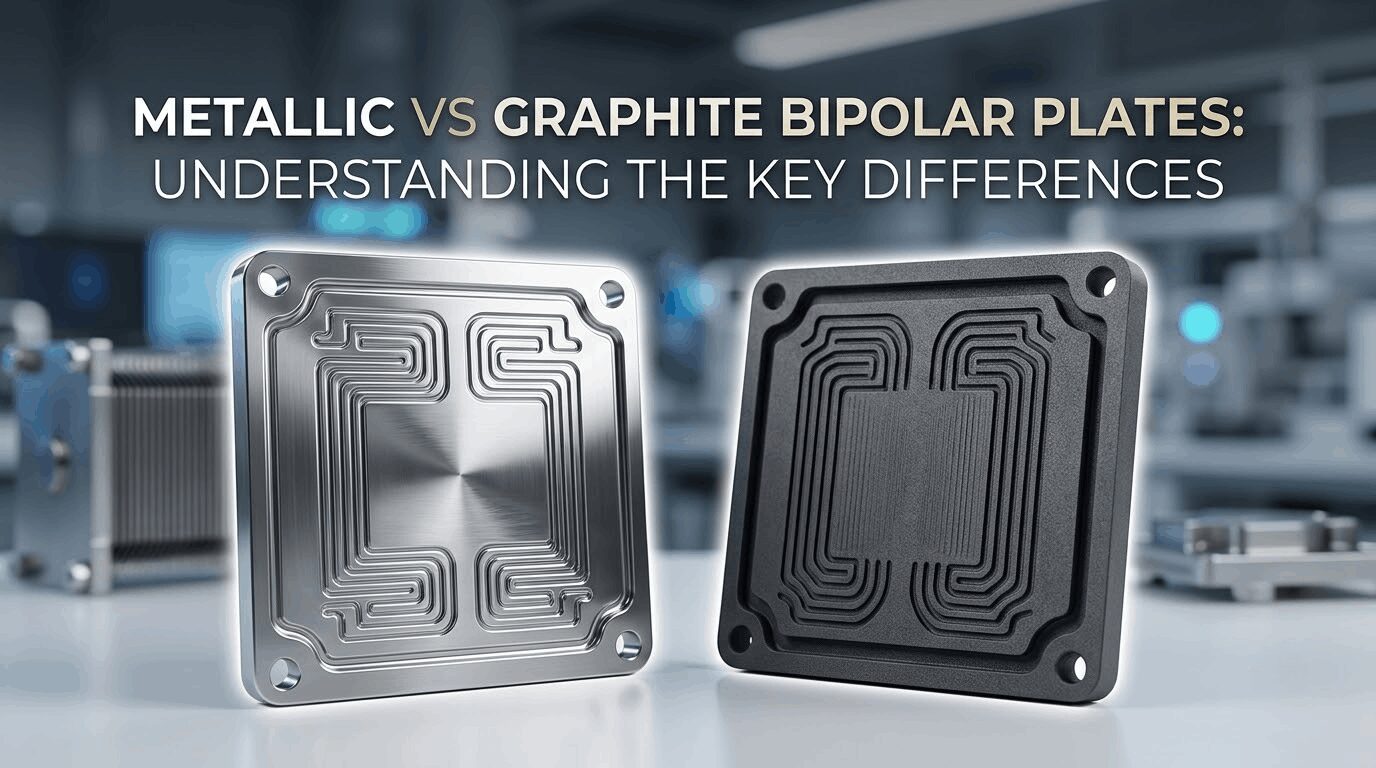
Metallic and graphite bipolar plates provide structural support and influence performance in PEM fuel cells. They distribute reactant gases across the active area, conduct electrical current between adjacent cells, manage thermal loads, and channel water out of the assembly. The plates must perform all these functions simultaneously inside a harsh electrochemical environment. Engineers primarily choose between metallic and graphite-based materials for these critical components.
Metallic plates provide high mechanical strength, allow for thin fabrication, offer good formability, and provide low gas permeability. Graphite plates deliver strong chemical stability and electrical conductivity, but they introduce brittleness and distinct manufacturing challenges. For bipolar plate suppliers, understanding these material trade-offs is important when selecting the appropriate manufacturing route and material for a PEM fuel cell stack.
What Are Metallic and Graphite Bipolar Plates?
Metallic Bipolar Plates
These plates are formed from high-strength metals. Manufacturers commonly use stainless steel, titanium, nickel alloys, and aluminum alloys. Metallic plates can be manufactured in extremely thin sections because the base material possesses high mechanical yield strength. This mechanical strength supports precise flow-field fabrication during manufacturing. Engineers specify these metals specifically for their low gas permeability and their ability to form complex geometries without cracking under pressure.
Graphite Bipolar Plates
Graphite serves as the historical baseline material for PEM fuel cells. The industry uses it heavily because of its excellent natural electrical conductivity and high chemical stability in acidic environments. Graphite does not undergo metallic corrosion, although its durability remains dependent on the material grade and operating conditions. However, solid graphite is inherently brittle. The material generally requires greater physical thickness to achieve the necessary structural performance. It often demands slow mechanical machining or complex additional processing to form the required gas flow channels without shattering the plate.
Metallic vs Graphite Bipolar Plates: Key Differences
Material selection for bipolar plates requires balancing competing mechanical and chemical priorities. No single material solves every engineering challenge perfectly.
| Factor | Metallic Bipolar Plates | Graphite Bipolar Plates |
| Mechanical strength | Generally higher | Lower |
| Thickness | Can be manufactured relatively thin | Generally requires greater thickness |
| Electrical conductivity | High, depending on alloy/surface | High |
| Corrosion resistance | Material/coating dependent | Generally strong |
| Gas permeability | Very low | Higher than metals |
| Formability | Strong advantage | Brittle and difficult to form |
| Manufacturing | Suitable for high-precision forming/etching | Often involves machining or moulding |
| Weight/volume | Thin construction can reduce stack volume | Greater thickness can increase volume |
You cannot apply these values universally across every fuel cell design. Actual performance depends heavily on the specific metal alloy, the grade of the graphite, applied surface coatings, the exact manufacturing method, and the internal operating environment of the stack. The primary engineering trade-off usually comes down to graphite’s natural corrosion resistance versus the mechanical strength and thinness of metal.
Corrosion Resistance and Durability
Corrosion can adversely affect fuel-cell performance and bipolar-plate durability. PEM fuel cells expose bipolar plates to demanding acidic and electrochemical conditions continuously. Metallic materials face significant chemical challenges here. They can experience active corrosion or passive-film formation. This passive oxide film acts as an electrical insulator, increasing the interfacial contact resistance and dropping the power output. Metallic corrosion can release ions that may adversely affect fuel-cell components, including the membrane electrode assembly.
Graphite provides strong chemical stability in this environment. It resists acidic attack naturally, but it introduces heavy mechanical and manufacturing limitations. For metallic plates to survive, manufacturers apply advanced protective coatings and surface engineering techniques. A proper conductive coating improves the corrosion resistance of the metal while maintaining the required electrical contact performance. You should never assume an uncoated base metal automatically provides better durability than solid graphite.
Mechanical Strength, Thickness and Gas Permeability
Metals generally provide a significant mechanical advantage in fuel-cell assembly. The higher mechanical strength allows engineers to design extremely thin plates. This thin profile is critical for building compact, high-density fuel cell stacks. Metals also offer excellent resistance to handling damage during automated factory assembly. Furthermore, solid metal provides reduced gas permeability, reducing gas permeation through the plate structure.
Graphite’s lower mechanical strength and natural brittleness restrict thin-plate designs. You must make the plate thicker to prevent it from cracking under the compressive load of the assembled stack. This brittleness makes fabricating complex flow-field geometries much more challenging. A brittle material limits how closely you can space the gas channels before the dividing walls snap during manufacturing.
Manufacturing and Production Considerations
The choice of material dictates the manufacturing process. Metallic plates support high-volume production techniques. Manufacturers use heavy stamping and forming presses to shape the metal. They also use laser processing for precise cutting. Photochemical etching provides a highly precise manufacturing approach for metallic bipolar plates. This chemical process dissolves the metal to create perfect flow-field channels without introducing physical stress or warping the thin plate. Engineers also apply surface treatments and conductive coatings directly to the formed metal.
Graphite plates require different handling. Manufacturers usually rely on slow CNC machining to cut flow fields into solid graphite blocks. Some advanced graphite composites allow for molding and compression processes, but these require expensive tooling. Graphite always demands greater care during handling and assembly because of its severe brittleness. The selected manufacturing method influences flow-field precision, production repeatability, total material utilization, and the final component cost. Photochemical etching can offer advantages for bipolar plates requiring fine or complex channel geometries.
When Are Metallic Bipolar Plates the Better Choice?
Metallic construction proves highly attractive for automotive and transportation-oriented PEM fuel cells. Vehicles require compact stack designs to fit under the hood. Applications requiring ultra-thin plates to maximize power density rely on metal. High-volume manufacturing lines use metal because it stamps and etches quickly and predictably. Metallic plates can be advantageous where precise, complex flow-field geometries and thin channel walls are required. When mechanical durability and resistance to road vibration are important, engineers specify coated metallic plates.
When Can Graphite Bipolar Plates Be the Better Option?
Graphite characteristics remain valuable for specific stationary applications. When a system has absolute, uncompromising corrosion resistance requirements, graphite is the baseline choice. Graphite can be considered where its chemical stability offers a significant advantage over the mechanical and manufacturing limitations. If the physical design allows for greater plate thickness and weight is not a primary concern, graphite works well. Engineers select it for systems where established, uncoated performance is prioritized over thin-sheet manufacturing techniques.
What Should Buyers Look for in Bipolar Plate Suppliers?
Procurement teams must evaluate manufacturers based on strict technical capabilities. You must verify the exact material grade and demand full metallurgical traceability. Check their ability to hold tight dimensional tolerances across the entire plate surface. Evaluate how accurately they can reproduce your specific flow-field geometry. Review their primary manufacturing process and the resulting surface finish.
If you specify metal, verify its coating capability. They must meet your exact corrosion and conductivity requirements. Confirm their maximum production volume to ensure they can scale with your project. Review their inspection protocols and quality documentation. Finally, test their prototyping speed and production repeatability. Careful supplier evaluation helps ensure that the supplied components match the required fuel-cell architecture and manufacturing specifications.
Metallic vs Graphite Bipolar Plates: Which Should You Choose?
Choose metallic plates when thin construction, high mechanical strength, low gas permeability, and scalable precision manufacturing are your primary priorities. Consider graphite, where extreme natural corrosion resistance is more important, and your design can accommodate the additional thickness and brittleness. Remember that metallic plates usually require corrosion protection and surface engineering depending on the specific metal alloy and the PEM operating conditions. The correct choice always depends directly on your fuel cell architecture, the operating environment, your manufacturing requirements, and the final production scale.
