

GLP-1 Weight-Loss Medications in 2026: The Complete Guide to Ozempic, Wegovy, Zepbound & the New Oral Pills
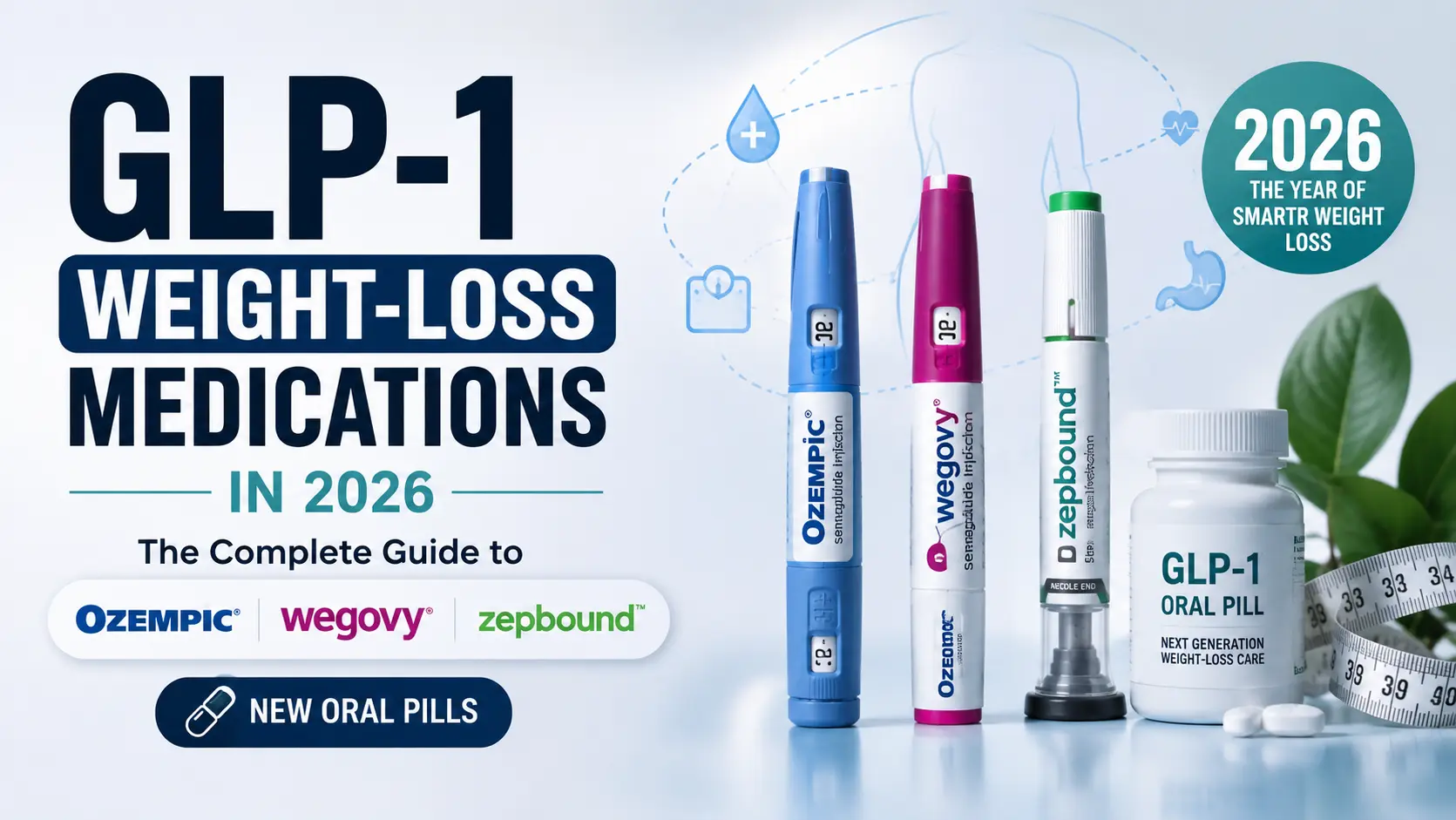
What GLP-1 medications actually are, and why everyone’s suddenly talking about them
Think back a few years. Unless you worked in a diabetes clinic, “GLP-1” meant nothing to you. Total blank. Now you can’t get away from it. Ozempic. Wegovy. Mounjaro. Zepbound. Your coworker’s on one. Your cousin swears by another. Half your feed is before-and-after photos and the other half is people arguing about them.
So you want the real picture. What do these drugs actually do? Would one even make sense for you? And what’s the fine print nobody mentions in the glossy ads? That’s the whole point of this piece. I’ll walk you through how they work, why so many of the “different” ones are really the same thing, how much weight you might genuinely lose, what shifted this year, and the side effects it’d be daft to ignore. Anytime a topic needs more room, I’ll send you to a fuller guide.
Fair warning, though. This is background reading. It isn’t medical advice, and I’m not your doctor. These are serious prescription drugs, they carry real risks, and what’s right for you hinges on your own health. Read this, then go have a sharper conversation with someone qualified.
How GLP-1 drugs work in the body
Start with the name. GLP-1, or glucagon-like peptide-1. It’s a hormone, and here’s the thing, your own gut pumps it out every time you eat. It does a few things at once. Tells the pancreas to release insulin when your blood sugar spikes. Slows down how quickly your stomach empties. And pings your brain to say, right, that’s enough now. Your body’s built-in appetite dial, basically.
The drugs? They’re copies of that hormone. The trick the scientists pulled off is making them last. Way longer than the real thing sticks around, which is how you get away with a single weekly jab instead of dosing yourself morning, noon and night. And the whole time it’s active, that “I’m satisfied” signal just… stays put.
Ask anyone who’s been on one and the stories rhyme. The nonstop mental noise about food? It dims. You eat less without white-knuckling it. That pull toward the fridge at 9pm quietly lets go. People literally call it “food noise,” and muting it is a huge chunk of why any of this works.
Oh, and one thing worth tucking away. These were diabetes drugs first. The weight loss was almost a side discovery, spotted once people were already taking them. That backstory matters, because it’s the reason a single drug keeps turning up under two names. Which, honestly, is where nearly everyone gets muddled.
The main GLP-1 medications in 2026
Right, slow down, because this is the bit that trips people up. A bunch of these “rival drugs”? Same medicine. Different sticker.
Semaglutide first. It’s what’s inside both Ozempic and Wegovy. Ozempic is the diabetes badge. Wegovy is the exact same molecule, just cleared for weight loss and usually dosed higher. So your friend “on Ozempic to slim down”? Nine times out of ten that’s the diabetes version, used off-label.
Tirzepatide next. Same trick. It powers both Mounjaro (diabetes) and Zepbound (weight loss). The difference here is that tirzepatide pokes at two gut hormones rather than one, and when they’ve tested the two molecules side by side, it’s usually come out ahead on average weight lost.
Strip the labels off and, really, the whole 2026 story is two molecules. Semaglutide and tirzepatide. Everything else, which one your doctor reaches for, is down to your health, how your gut handles it, what your insurance will wear, and frankly whatever the pharmacy can actually get hold of that month. Want the proper head-to-head? We lay it out in our comparison of Ozempic vs Wegovy vs Zepbound vs Mounjaro.
How much weight can you realistically lose?
The question you actually clicked for. So let’s not dress it up.
In the big studies, semaglutide users shed about 15% of their body weight on average, give or take, across a year and change. Tirzepatide climbed higher, into the low twenties for loads of people. Make that real. At 220 pounds, 15% is roughly 33 pounds gone. 20% is nearer 44.
But here’s where averages get slippery. Some folks drop weight fast. Others crawl on the identical dose, and no one, truly no one, can call which camp you’ll land in before you start. Those numbers also quietly assume you keep taking the thing and don’t eat like it’s your last week on earth. Powerful tool, yes. Magic wand you wave at a rubbish diet forever? No. And the catch first-timers never see coming: all that trial data is what happened while people stayed on the drug. Coming off it is a completely different story. Hang on, we’ll get there.
What’s new with GLP-1s in 2026
If your info is a couple of years stale, a few things have moved that are worth catching up on.
Pills. At last. That weekly needle put a lot of people off entirely. Then January 2026 rolled around and an oral Wegovy hit the market. There’s a second one too, a small-molecule GLP-1 called orforglipron. It actually landed FDA approval back in April 2026 under the brand name Foundayo, in a record-fast review, so it’s now a real option alongside the Wegovy pill rather than something still waiting in the wings. Pills are also simpler to churn out and store, so over time that should loosen supply and pull prices down. Hate needles? Our guide to oral GLP-1 pills in 2026 gets into how the pill measures up to the jab.
They keep getting stronger. A beefed-up Wegovy dose has been under review, with trial folks shedding close to 19% of their body weight. And a combo drug, CagriSema, semaglutide bolted to a second hormone, has clocked average losses near 20%, due to arrive sometime in 2026. The ceiling just keeps lifting.
Getting hold of them changed, cuts both ways. Telehealth outfits and pharmacy discount schemes have made starting easier than ever, sometimes $150 to $200 a month rather than those wince-inducing four-figure prices from a couple of years back. Downside? Insurance is splitting down the middle. Coverage mostly holds for diabetes and heart stuff, but it’s clamping down hard on weight-loss-only use. So what you fork out leans heavily on why it’s prescribed.
The side effects worth knowing about
No straight-talking guide skips this. GLP-1s are reckoned safe for the right patients. But “safe” was never the same as “no side effects,” and going in clear-eyed makes the ride a lot smoother.
Most of the grief is digestive, and it falls right out of how the drug works. You’ve slowed the stomach down, so, yep, nausea, that’s the classic opener. Then constipation, the odd run of diarrhea, some burping, and a fullness that tips into properly uncomfortable if you inhale your dinner. For most people it’s roughest early doors, and each time the dose bumps up. Then it eases. Which is exactly why doctors start you low and crawl upward. We’ve gathered the practical fixes in our guide to GLP-1 side effects and managing nausea and constipation.
Then the sneakier stuff, the bits that keep landing in the news. Losing weight fast, by any method, can trigger a spell of hair shedding, and a 2026 dig through medical records at the University of Pennsylvania found GLP-1 users hit hair loss at a noticeably higher rate than people on other diabetes drugs, though it was the non-scarring, usually-grows-back kind. Fretting about that? Our full breakdown of whether Ozempic causes hair loss gets into what the science actually shows. Rapid loss can hollow out the face too, the whole “Ozempic face” thing, and it can cost you muscle alongside the fat unless you’re actively fighting for it. Which is why we split those out into guides on preventing muscle loss on GLP-1s and on Ozempic face.
And the genuinely serious risks deserve daylight: pancreatitis, gallbladder trouble, warnings around certain thyroid tumors. That, right there, is why you don’t order these off some website that asks you nothing. A licensed clinician in the loop. Non-negotiable.
What GLP-1 medications cost and how people get them
For a lot of people, cost decides the whole thing. And honestly? It’s all over the map. Decent insurance for an approved use, and you might barely pay a thing. None at all, and list prices have long sat north of a grand a month, though the 2026 rush of telehealth, discount cards and cheaper pills has hauled the starting point down toward $150 to $200 for plenty of folks.
Two routes, mostly. Your own doctor, who actually sizes you up and handles the script and the check-ins. Or a telehealth platform that bundles the consult and the meds into one. Telehealth’s handy, often cheaper, but it puts more on you, being straight about your history, and actually turning up for follow-ups. Whichever way, a real clinician belongs in it. Some site offering to post you a weight-loss jab with zero medical questions? That’s not a deal. That’s the warning light.
If you’d rather not take a drug: the alternatives
Loads of people want nothing to do with a jab or a daily tablet. Completely fair. That search for something gentler has turned “natural alternatives to Ozempic” into one of the year’s most-Googled health phrases. So, bluntly: nothing, no supplement, no tea, no miracle berry, actually does what a GLP-1 does, and anything flogged as “nature’s Ozempic” earns a hard side-eye. That said, a few habits do tug on the same ropes. More protein and fiber, which really do help you feel full. Lifting weights. Sleeping properly. And working out what’s actually driving the snacking to begin with. We sift the real from the nonsense in our look at natural alternatives to Ozempic, and lay out a proper plan in how to lose weight without Ozempic. None of it goes toe-to-toe with the drugs. But for some people it’s the right place to start. Or the way they cling onto their progress later on.
Who GLP-1s are for, and who should be careful
Broadly speaking? They’re pointed at adults with type 2 diabetes, and adults with obesity, or people who are overweight and hauling around something extra like high blood pressure or sleep apnea. And more and more they’re being studied and cleared for heart and blood-vessel benefits too, which is a big part of why the medical world takes them dead seriously.
Not for everyone, mind. A history of certain thyroid cancers, or a rare hormonal condition, and they’re generally off the table. Pregnant, trying to be, or a history of pancreatitis, and you need a proper sit-down with your doctor first. And they were never meant as a cosmetic dash to lose five pounds before a wedding. The risk-versus-reward only pencils out when there’s a real health reason in play. This is precisely the sort of call that belongs with someone who knows your history. Not some stranger on the internet.
What happens when you stop
Here’s the part that ambushes people. GLP-1 drugs run your weight while you’re on them. They don’t permanently rewire anything. Quit, and the appetite comes charging back, and a 2026 systematic review found a fair slice of the lost weight tends to creep back over the following year unless you’ve already nailed down new habits.
Does that make them pointless? Not by a mile. But it does change how you should see them. Picture the drug as buying you a window. Time to rebuild how you eat and move. Not a one-and-done you get to walk away from and forget. We dig into the research, and how to actually hold the line, in our guide to what happens when you stop taking GLP-1s.
Frequently asked questions
Is Ozempic the same as Wegovy?
Same active ingredient, semaglutide. Ozempic’s cleared for type 2 diabetes; Wegovy for weight management, usually at a higher dose. Two brands, two official uses, one medicine underneath.
How fast does a GLP-1 work for weight loss?
Appetite usually eases off within a week or two. The weight itself, though? That’s a slow burn, coming off over months as the dose climbs. Those headline trial numbers reflect a year or more. Not a couple of weeks.
Do you regain the weight after stopping?
Often, at least a chunk of it. Appetite bounces back when you stop, and research shows plenty of people regain a big share of what they lost inside a year, unless lasting diet and lifestyle changes are already bedded in. Worth thinking through before you even begin.
Does GLP-1 cause hair loss?
Indirectly, it can. Fast weight loss is a known trigger for temporary shedding, and 2026 research found higher hair-loss rates in GLP-1 users than in people on some other diabetes drugs. Silver lining? This kind usually grows back. Our article on Ozempic and hair loss covers what helps.
Can I get a GLP-1 without diabetes?
Yep. Loads of people take them purely for weight management, through the weight-loss brands, as long as a clinician signs off that they’re a good fit. Coverage and cost just get trickier without a diabetes diagnosis.
Are the new GLP-1 pills as good as the injections?
The oral options that landed in 2026 are a real gift for anyone who hates needles, though how well they work and how they’re dosed can differ from the jabs. We compare them properly in our guide to oral GLP-1 pills.
Medical disclaimer: This article is for general educational purposes only and does not constitute medical advice, diagnosis, or treatment. GLP-1 medications are prescription drugs with potential risks and are not suitable for everyone. Always consult a qualified healthcare professional before starting, stopping, or changing any medication or weight-loss plan. Never disregard professional medical advice because of something you have read here.
Written by the Global Journal Post health desk and reviewed for factual accuracy against current, publicly available medical sources including peer-reviewed research and FDA-approved product information. Last updated August 2026.
