

Stainless Steel 303 Square Bars for Precision Engineering Applications
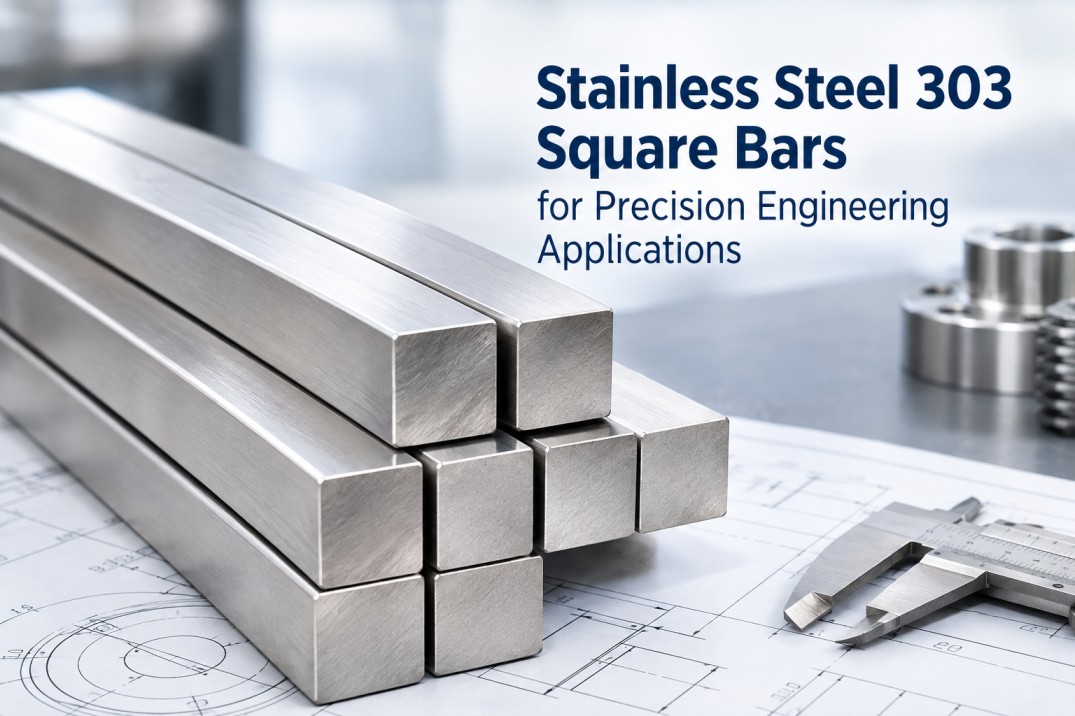
Stainless Steel 303 Square Bars, designated as UNS S30300 Square Bars, are free-machining austenitic products used for precision components. The addition of sulphur or selenium impacts the steel matrix. The addition of sulphur or selenium changes the steel matrix to improve machinability, causing metal chips to break down cleanly during high-speed cutting. This allows the material to achieve an excellent surface finish and maintain strict dimensional accuracy during aggressive machining operations, while providing adequate corrosion resistance for standard engineering environments.
What are Grade 303 Square Bars?
Grade 303 is a non-magnetic austenitic stainless steel. The square bar profile is manufactured through hot rolling or cold drawing processes. Hot-rolled bars have a rougher, scaled finish, whereas cold-drawn profiles maintain sharp, 90-degree corners and tighter dimensional tolerances. It carries the UNS S30300 designation. The chemistry includes 17-19% chromium and 8-10% nickel. The defining characteristic is the added sulphur. This specific composition breaks up metal chips during machining. This composition prevents galling on the tool edge and reduces wear on cutting inserts.
Why This Material is Preferred for Precision Engineering
Machinists choose this grade for its excellent machinability. It allows for efficient CNC machining and supports high-volume production runs. Spindle speeds can run faster than other 300-series grades. Drilling, turning, milling, and threading operations proceed without constant tool changes. The resulting components retain excellent dimensional accuracy. The final parts show a decent surface finish right off the machine. Good corrosion resistance handles typical indoor industrial exposure without requiring secondary plating.
Key Properties
The physical and mechanical properties determine industrial viability. The chemical composition balances chromium and nickel with sulphur. Tensile strength ranges from 500 to 700 MPa, depending on the heat treatment condition and bar thickness. Yield strength is typically 190 MPa minimum for annealed bars. Hardness is close to 200 to 262 HB. Corrosion resistance withstands mild atmospheric conditions but pits in marine environments. Machinability is the highest among all austenitic grades. Surface finish post-machining is exceptionally smooth. Temperature performance limits usage. Continuous exposure above 760°C causes carbide precipitation and brittleness.
Important Factors to Consider Before Selection
Material Specifications
Industry standards define material testing and compliance. Common specifications include ASTM A276 and ASTM A479. Applicable EN/DIN specifications comply with European fabrication requirements. The UNS S30300 designation is the universal identifier across global markets.
Dimensions and Tolerances
Buyers must specify exact square bar dimensions prior to ordering. Standard cross-sections range from small precision profiles to thick blocks. Length is supplied in random mill lengths or specific cut-to-size increments. Wall and profile dimensions must align with required dimensional tolerances. Ordering custom sizes reduces raw material waste during the initial milling stages.
Machining Requirements
Assess the exact operations required for the component. This material suits high-speed CNC turning and milling. It handles deep hole drilling and fine threading without severe tool wear. CNC lathe operators prefer this grade because it does not require constant coolant pressure adjustments or frequent tool insert replacements. Precision component manufacturing requires stable materials.
Operating Environment
Evaluate where the machined part will operate. General industrial environments are safe. Outdoor applications require assessment of local atmospheric pollutants. Moisture exposure or contact with chlorides demands a different grade. In highly corrosive situations, the sulphur inclusions in 303 act as initiation sites for pitting.
Stainless Steel 303 Square Bar Applications
Specific manufacturing sectors rely on Stainless Steel 303 Square Bar Applications to maintain production output. The primary end-use is in precision engineering and CNC-machined components. Automotive component manufacturers use it for non-corrosive structural parts in dry zones. It forms shafts, pins, and mechanical bushings. Fabrication facilities machine fasteners, threaded fittings, and fluid connectors from this metal. Instrumentation equipment, heavy industrial machinery, and electrical automation equipment often contain internal 303 components.
Advantages of SS 303 Square Bars
The operational benefits of SS 303 Square Bars contribute to production efficiency on the shop floor. Operators achieve consistent dimensions across large production batches. The material leaves a high-quality surface finish, removing the need for secondary grinding or polishing. It handles the production of complex components with intricate geometries. Low maintenance requirements apply when parts operate in appropriate environments.
Grade 303 vs 304 Square Bars
Engineers frequently evaluate 303 against 304. Grade 303 is preferred for machining-intensive applications. Grade 304 is selected when corrosion resistance and weldability dictate the final design.
| Property | Grade 303 | Grade 304 |
| Machinability | Excellent (Free-machining) | Moderate |
| Corrosion Resistance | Moderate | High |
| Weldability | Poor (due to sulfur content) | Excellent |
| Strength | Similar | Similar |
| Surface Finish | Very smooth post-machining | Good |
| Precision Machining suitability | Highly suitable | Fair |
| Typical Applications | Shafts, gears, fittings | Tanks, food processing parts |
Common Mistakes to Avoid
Selecting the wrong stainless steel grade causes part failure in the field. Ignoring required dimensions and tolerances adds unnecessary machining time. Choosing 303 for highly corrosive environments causes rapid oxidation and pitting. Overlooking specific machining requirements wastes tool life. Using this grade for welded assemblies is a major mistake, as the sulfur content causes hot cracking in the weld zone. Buying without material certification leaves material chemistry unverified, which causes issues during final inspection. Ignoring applicable ASTM standards creates compliance risks for the final assembly.
Tips for Selecting a Reliable Stainless Steel 303 Square Bar Supplier
A reliable Stainless Steel 303 Square Bar Supplier provides material certifications with every single order. Check for Mill Test Certificates (MTC) to verify the exact chemistry and mechanical properties. Confirm ASTM compliance before issuing a purchase order. The vendor must ensure dimensional accuracy and conduct routine quality testing. Ask about size and stock availability to prevent unexpected production delays. Customisation options for cut lengths reduce scrap metal. Check their packaging standards to prevent transit damage to the bar edges. The vendor should offer technical support. Suppliers should have robust logistics networks to deliver heavy steel loads on strict industrial schedules. Evaluate domestic and export supply capability if managing global manufacturing operations.
Conclusion
Selecting the right material requires evaluating the required dimensions, machining operations, and material properties. Grade 303 is practical for precision engineering applications. The machinability and consistent surface finish support lean manufacturing and fast cycle times. Secure certified, dimensionally accurate material from an experienced manufacturer or supplier to maintain production stability. Stainless Steel 303 Square Bars remain a standard input for heavy industrial and precision machining.
