

NASA’s Roman Space Telescope Will Launch On August 30
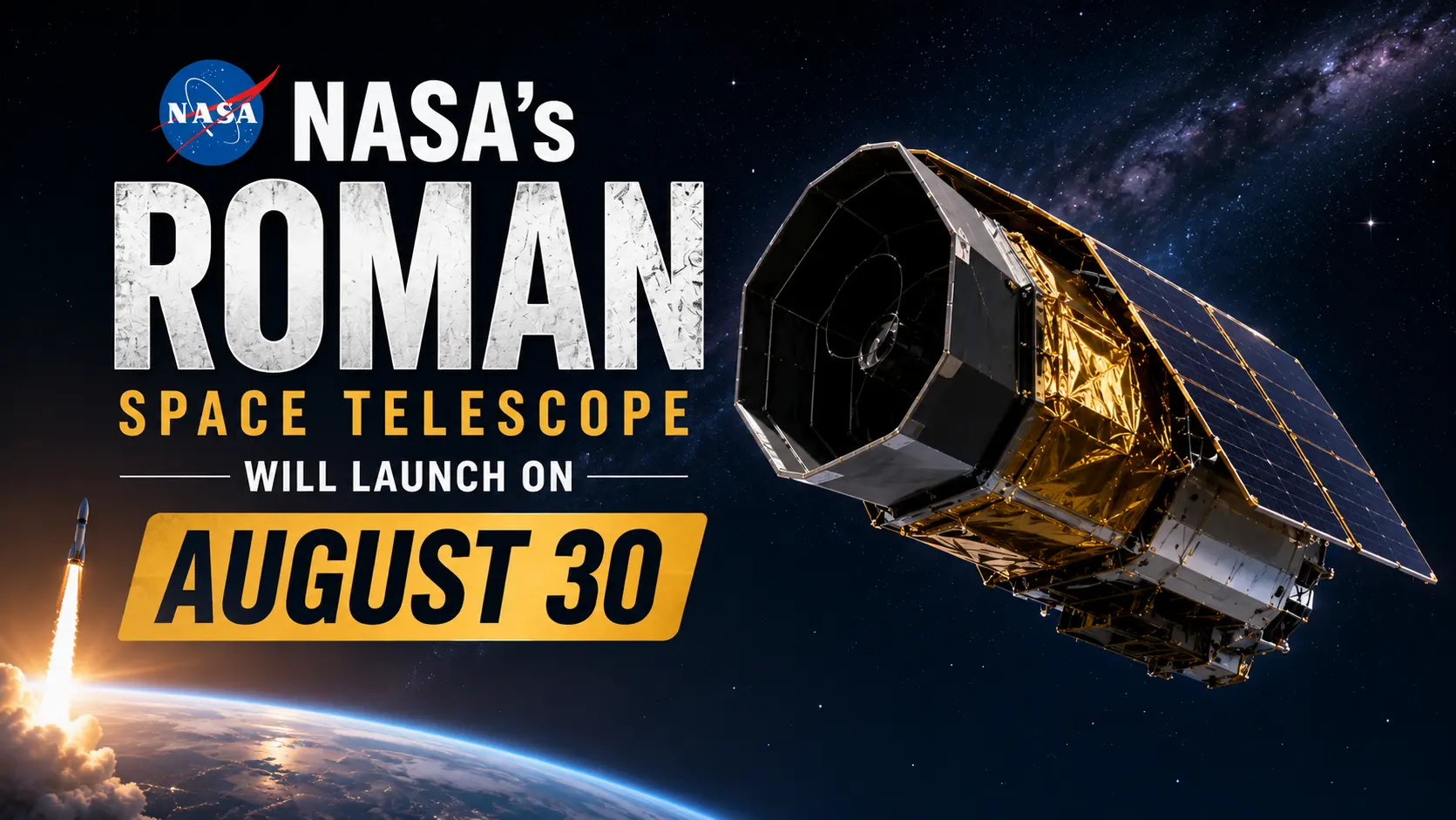
Quick Answer: NASA’s Roman Space Telescope launches August 30, 2026, at 7:26 a.m. EDT aboard a SpaceX Falcon Heavy from Launch Complex 39A at Kennedy Space Center in Florida. Live coverage begins at 6:20 a.m. EDT, with a backup slot held for 31 August at 7:22 a.m.
A new giant is about to leave Earth. The Nancy Grace Roman Space Telescope is NASA’s next flagship observatory. It is built to tackle some of the universe’s deepest puzzles, from dark energy to distant worlds.
Key Points
- Liftoff: 7:26 a.m. EDT (11:26 UTC), Sunday 30 August 2026.
- Rocket: SpaceX Falcon Heavy from Kennedy’s Launch Complex 39A.
- Coverage: starts at 6:20 a.m. EDT on nasa.gov/live.
- Destination: Sun–Earth Lagrange point L2, about a million miles away.
- Mirror: 2.4 metres wide, matching Hubble, with a view at least 100 times larger.
- Mission: five years planned, with a goal of ten.
When NASA’s Roman Space Telescope launches August 30
NASA and SpaceX are targeting no earlier than 7:26 a.m. EDT on Sunday. The launch team completed its Flight Readiness Review on 21 August, clearing the observatory for final work. On the same day, crews sealed Roman inside the rocket’s 43-foot fairing.
Construction was finished on 25 November 2025. The observatory reached Kennedy on 21 June 2026, and fuelling was complete by 21 July. The mission is arriving about nine months ahead of its old May 2027 readiness date, a rare feat for a project this size, as ScienceDaily has reported.
A Telescope Named For a Pioneer
Roman honours Nancy Grace Roman, NASA’s first chief astronomer. She helped plan Hubble and earned the nickname “Mother of Hubble”. The telescope carrying her name flips Hubble’s approach. Where Hubble and James Webb stare deep and narrow, Roman sweeps wide and fast. It was previously known as WFIRST, the Wide-Field Infrared Survey Telescope.
Its 2.4-metre primary mirror is the same size as Hubble’s. That mirror came from optics donated to NASA by the National Reconnaissance Office, as Wikipedia records. The result is a survey machine with familiar sharpness but a huge field of view.
What Roman Will Study
Roman’s science list is bold. It will investigate dark energy, the mysterious force driving the universe’s accelerating expansion. It will map billions of galaxies, probe dark matter, and study black holes. The telescope will also hunt exoplanets using gravitational microlensing, a method sensitive to worlds only a few times the mass of the Moon.
The numbers are striking. NASA says Roman could reveal around 100,000 planets, more than all previous planet-hunting missions combined. Space.com reports researchers are keen to study thousands of these worlds and see how closely they resemble planets in our own solar system.
Inside the Observatory
The telescope carries two instruments, both fitted in December 2024. The Wide-Field Instrument (WFI) is a 300.8-megapixel camera. It captures visible and near-infrared light from 0.48 to 2.30 micrometres across a 0.28-square-degree field, at a resolution of 0.11 arcseconds. Its detector array uses 18 H4RG-10 sensors from Teledyne.
The second tool is the Coronagraph Instrument (CGI). This high-contrast camera blocks the glare of stars using deformable mirrors, so faint planets become visible. It works from 575 to 825 nanometres and acts as a technology demonstrator for the future Habitable Worlds Observatory. The full spacecraft weighs about 10,500 kilograms at launch.
The Journey to L2
After launch, Roman will separate from the rocket and travel to the second Sun–Earth Lagrange point, or L2. This spot sits about a million miles from Earth, in the opposite direction to the Sun. SpaceDaily notes the trip takes roughly 30 days, followed by a three-month checkout before science begins.
The primary mission lasts five years, with a goal of ten. All of Roman’s data will be made public after processing.
How to Watch It Live
Live coverage streams on nasa.gov/live from 6:20 a.m. EDT. Technology.org confirms liftoff is set for no earlier than 7:26 a.m. Eastern, with the backup the next day. NASA will also share blog updates, photos and on-demand video shortly after liftoff. Audio-only coverage is available too. Fans can follow @NASARoman on X, Facebook and Instagram.
Briefings Before Launch
A busy schedule fills Saturday 29 August. A science briefing runs at 9 a.m. EDT, followed by a prelaunch news conference at 10:30 a.m. At 11:45 a.m., NASA Administrator Jared Isaacman is expected to fly past the rocket and telescope on the pad in his jet, weather permitting. A postlaunch news conference follows on Sunday at 9:30 a.m.
Who Built Roman
The mission is led by NASA’s Goddard Space Flight Center in Maryland, with the Jet Propulsion Laboratory, Caltech/IPAC and the Space Telescope Science Institute sharing science support. Industrial partners include BAE Systems, L3Harris Technologies and Teledyne Scientific & Imaging.
International partners are ESA, JAXA, France’s CNES and Germany’s Max Planck Institute for Astronomy. SpaceX provides the Falcon Heavy launch service, managed by NASA’s Launch Services Program. The mission carries a price tag of about US$4.3 billion.
FAQs
- When does NASA’s Roman Space Telescope launch?
Ans: Roman is set to lift off at 7:26 a.m. EDT on Sunday 30 August 2026. A backup slot is held for 31 August at 7:22 a.m. - Which rocket will carry Roman?
Ans: A SpaceX Falcon Heavy will launch Roman from Launch Complex 39A at Kennedy Space Center in Florida. - Where is Roman going?
Ans: It will travel to the Sun–Earth Lagrange point L2, about a million miles from Earth, taking roughly 30 days to arrive. - What will Roman study?
Ans: Roman will explore dark energy, dark matter, exoplanets and black holes, while mapping billions of galaxies across the sky. - How is Roman different from Hubble?
Ans: Its mirror matches Hubble’s size, but its view is at least 100 times wider, so it surveys the sky far faster. - Can viewers watch the launch live?
Ans: Yes. Free coverage streams on nasa.gov/live from 6:20 a.m. EDT.
