

Are There Grants and Incentives to Buy an Electric Tractor? Here’s What Farmers Need to Know
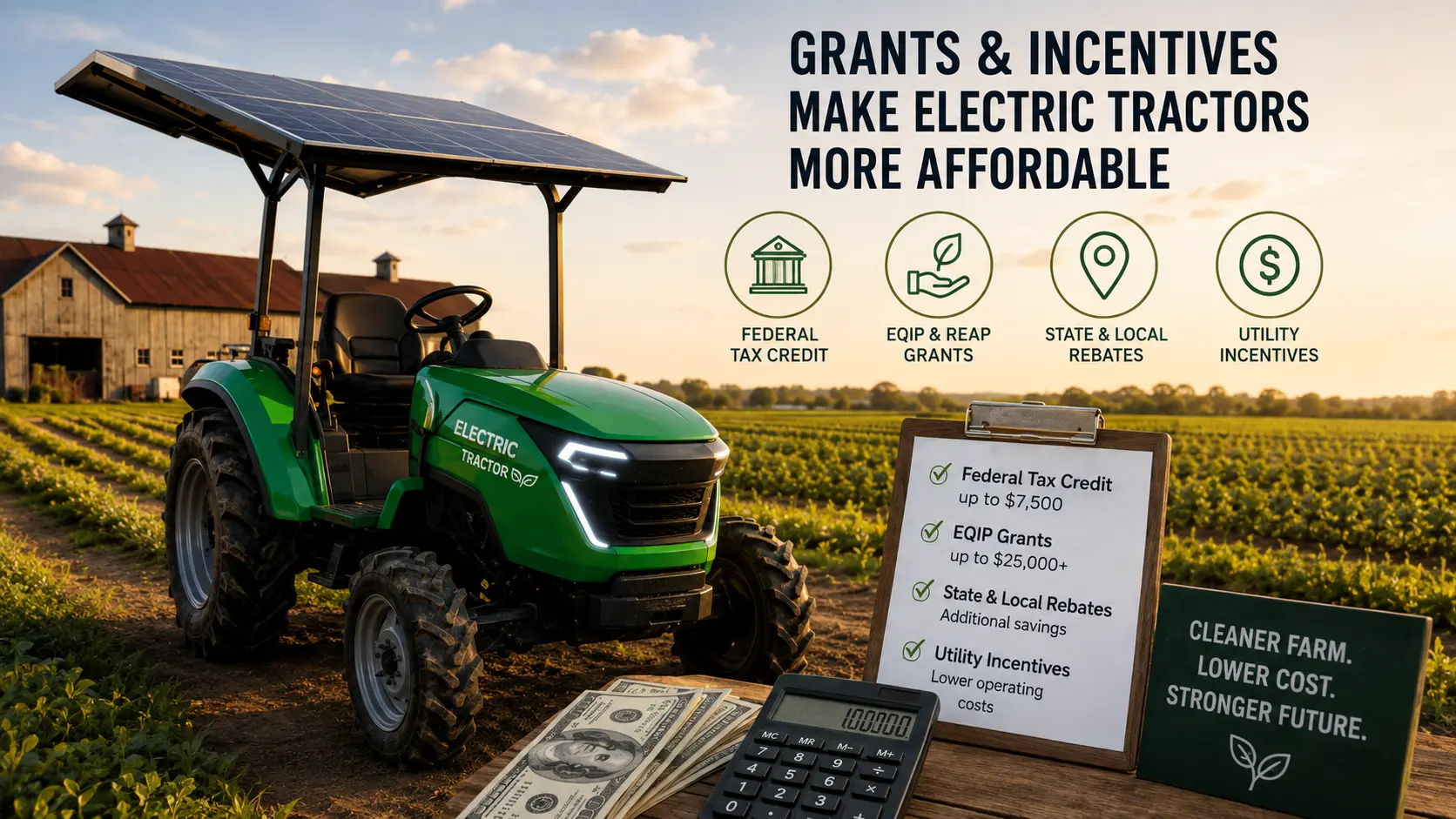
Switching from a diesel tractor to an electric tractor is no longer just an environmental decision; it’s a financial one, too. While machines such as the GoSun Moonrider are bringing solar tractor technology to small and mid-size farms, more and more federal, state, and local programs are making it even more affordable than the price tag. In many instances, farmers who purchase an electric tractor have received a rebate and/or a grant ranging from 30% to more than 50% of the tractor’s cost, and in some regions, grants can amount to as much as 80% of the tractor’s cost.
If you’ve been considering buying an electric tractor for your farm, vineyard, or homestead, but you’ve been reluctant to purchase due to cost, here is a breakdown of the incentives that can make the economics of the tractor purchase look a lot different.
Why Incentives Exist for Electric Farm Equipment
Agricultural electrification is seen as a potentially valuable opportunity to help implement both national and international climate policy and support rural economies, while diesel tractors represent one of the biggest sources of on-farm emissions and fuel costs. That’s why electric tractors, along with other clean energy investments such as installing solar farms and electric vehicle (EV) charging stations, are eligible for a variety of funding, grants, and tax credits focused on the cost of clean technology.
These are perfect opportunities for a company such as GoSun, which has a Moonrider tractor that has electric-vehicle performance with an optional solar canopy. Agricultural electric vehicles (EVs) powered by solar energy tick all of these incentive programs’ boxes and effectively do so: it reduces emissions, cuts diesel use, and contributes to long-term small and mid-size farm resiliency.
Diesel vs. Electric: The Real Operating Cost Savings
Grants and tax credits chip away at the upfront price, but the bigger financial story for most farmers happens after the purchase, in the day-to-day cost of simply running the machine. This is where an electric tractor pulls ahead of a diesel tractor by a wide margin, and it’s a big part of why programs like EQIP and REAP exist in the first place.
Fuel costs alone tell most of the story. A diesel tractor needs regular trips to the pump, and diesel prices fluctuate with the broader fuel market, adding unpredictability to a farm’s operating budget. An electric tractor eliminates that expense; there’s no diesel fuel to buy, ever. Instead, the tractor charges from standard electricity, which costs a fraction of what diesel does per hour of work, and that gap tends to widen further when energy prices spike.
Solar charging can push that cost even lower, sometimes to zero. This is where a solar tractor really separates itself from a standard electric tractor. Machines like the GoSun Moonrider offer an optional solar canopy that charges the battery directly from sunlight while the tractor is working in the field or simply parked in the yard.
Maintenance costs drop dramatically too. Diesel engines rely on oil changes, filter replacements, fuel injectors, belts, and a long list of moving parts that wear down and need regular servicing. Electric drivetrains have far fewer components that can fail, no oil to change, and no fuel filters to replace, which means fewer trips to the shop and fewer surprise repair bills over the life of the machine.
The numbers add up fast. GoSun estimates that five-year ownership costs for the Moonrider 27 run around $21,000, compared to roughly $38,000 for a comparable compact diesel tractor over the same period, a gap of nearly $17,000 once fuel, maintenance, and repairs are factored in.
Want to see how an electric tractor can reduce operating costs? Check the Moonrider 27 and its diesel savings estimates.
So, incentive programs help farmers get past the upfront price tag, but it’s the lower cost of electricity, and the possibility of free solar charging that keeps the savings coming year after year.
Federal Programs Worth Knowing
Federal Investment Tax Credit (ITC). For farmers who opt for an electric tractor in combination with a solar carport system, with the power of the federal tax credit, known as the Investment Tax Credit, could help them save 30% on the cost of the investment. This directly impacts the electric tractor and solar installation, one of the easier incentives to claim, and details and forms are available directly from the IRS.
Want to see the GoSun Moonrider 27 tackle real fieldwork? Watch it in action and see the power, torque, and quiet performance for yourself.
EQIP — Environmental Quality Incentives Program. Administered by the USDA’s Natural Resources Conservation Service (NRCS), EQIP was created to encourage producers to fight climate change by weaving conservation practices into everyday farm operations. Provides financial and technical support to farmers switching to cleaner equipment and will subsidize more than 50 percent of the retail price for an electric tractor. Here are a couple of key qualifying points to keep in mind:
- Your farm’s average Adjusted Gross Income (AGI) must be $900,000 or less.
- In most participating states, you’re required to scrap your existing diesel tractor as part of the program.
- The replaced diesel tractor typically must meet a minimum horsepower threshold of 25 HP.
The list of states with current equity funding is fairly long, and includes Alaska, Arizona, California, Colorado, Connecticut, Delaware, Idaho, Illinois, Indiana, Iowa, Kansas, Maine, Maryland, Massachusetts, Michigan, Minnesota, Montana, Nebraska, Nevada, New Hampshire, New Jersey, New Mexico, New York, North Dakota, Ohio, Oregon, Pennsylvania, Rhode Island, South Dakota, Utah, Vermont, Washington and Wyoming. The best way to apply is to contact your local NRCS office directly, as applications and requirements may differ by county and year.
REAP — Rural Energy for America Program. REAP provides grants and loan guarantees to farmers and rural small businesses investing in renewable energy systems and energy-efficient equipment. Because it’s designed broadly around agricultural electrification, REAP funding can be applied toward purchasing an electric tractor as part of a farm’s broader clean energy strategy, particularly when paired with solar infrastructure like a solar farm array or a dedicated charging setup.
You can get a loan for an electric tractor Here. OR CLICK HERE
Together, EQIP and REAP form the backbone of federal support for farmers moving away from diesel and toward electric vehicles for their operations, and both can substantially reduce the net cost of a machine like the GoSun Moonrider.
State and Local Incentives
Beyond federal programs, some states and regional agencies have rolled out their own rebate and voucher systems:
- California’s CORE Program offers point-of-purchase vouchers specifically for heavy-duty commercial electric equipment, which can apply to qualifying electric tractors.
- Regional air districts in California also fund diesel-to-electric replacements through initiatives like the FARMER Program, aimed at reducing agricultural emissions at a local level.
- Minnesota has introduced a competitive electric farm equipment rebate grant program administered through the state’s Department of Agriculture, giving farmers another avenue for cost-sharing.
- Iowa accepts NRCS applications continuously, but has set September 25, 2026, as the deadline to be considered for 2027 funding, a useful date to have on your calendar if you’re planning.
- Washington State runs an incentive program with a strict process: applications must be submitted before you purchase your equipment. Applications open September 4, 2026, and any equipment purchased under the program must be paid for in full and received on-farm by June 1, 2027.
These regional programs illustrate an important point: timing and paperwork matter just as much as eligibility. Several of these incentives require you to apply before making a purchase, not after, so it pays to research your state’s specific program well ahead of when you actually plan to buy.
Don’t Overlook Utility Rebates
There are also local rebates for agricultural electrification from many electric utilities and community choice aggregators. The utility-level incentives often aren’t as well known as the federal tax credits, but they can be just as significant in terms of savings when combined with a program such as EQIP or REAP. It may be worthwhile to contact your local utility company to inquire if there are rebates available for upgrading electric vehicles or electric equipment on farms.
Putting It All Together
For farmers considering an electric tractor like the GoSun Moonrider, the path to ownership often looks less like a single purchase and more like a funding puzzle: a federal tax credit here, an EQIP grant there, potentially a state voucher or utility rebate layered on top. Once those factors are considered, the cost of converting from diesel-powered tractors to electric-powered tractors powered by solar electricity can plummet below the face value.
As deadlines come and go, and program requirements change constantly, like Iowa’s pre-purchase application requirement and the cutoff for programs in Washington in 2026, the best rule of thumb is to call your local NRCS office and review your state’s department of agriculture’s website before buying. An electric tractor can be much more within reach with the help of the right combination of grants and incentives.
FAQs
How much of an electric tractor’s cost can grants actually cover?
Incentives are available for between 30% and more than 50% of the purchase price depending on the situation, and depending on the region, up to 80% of the purchase price. The highest savings are from pairing a federal program, such as EQIP, with a state incentive like a voucher or a utility rebate.
Do I have to scrap my old diesel tractor to qualify for EQIP funding?
Yes, in most states that are participating, the USDA’s Environmental Quality Incentives Program generally does call for retiring an existing diesel tractor (usually 25 HP or greater) to be included in the application. Requirements differ from state to state; please check with your state NRCS Office.
Is there an income limit to qualify for these programs?
Yes, for EQIP specifically. Your farm’s average Adjusted Gross Income (AGI) must be $900,000 or less to be eligible. Other programs, like state vouchers or utility rebates, may have different or no income restrictions.
Can I apply for incentives after I’ve already bought an electric tractor?
It depends on the program. Some, like EQIP and REAP, accept applications tied to planned purchases, while others, such as Washington State’s program, require you to apply and get approved before buying any equipment. Always check your state’s process ahead of time to avoid missing out.
Are there deadlines I should know about for 2026-2027?
Yes. Both Iowa’s NRCS and Washington State’s NRCS have September 25, 2026, as the deadline for applications for consideration of funding for 2027, and equipment must be purchased and on-farm by June 1, 2027. Check with your local agriculture department early to know deadlines by state.
