

GPU Cloud Server: The Smart Choice for AI and High-Performance Computing in 2026
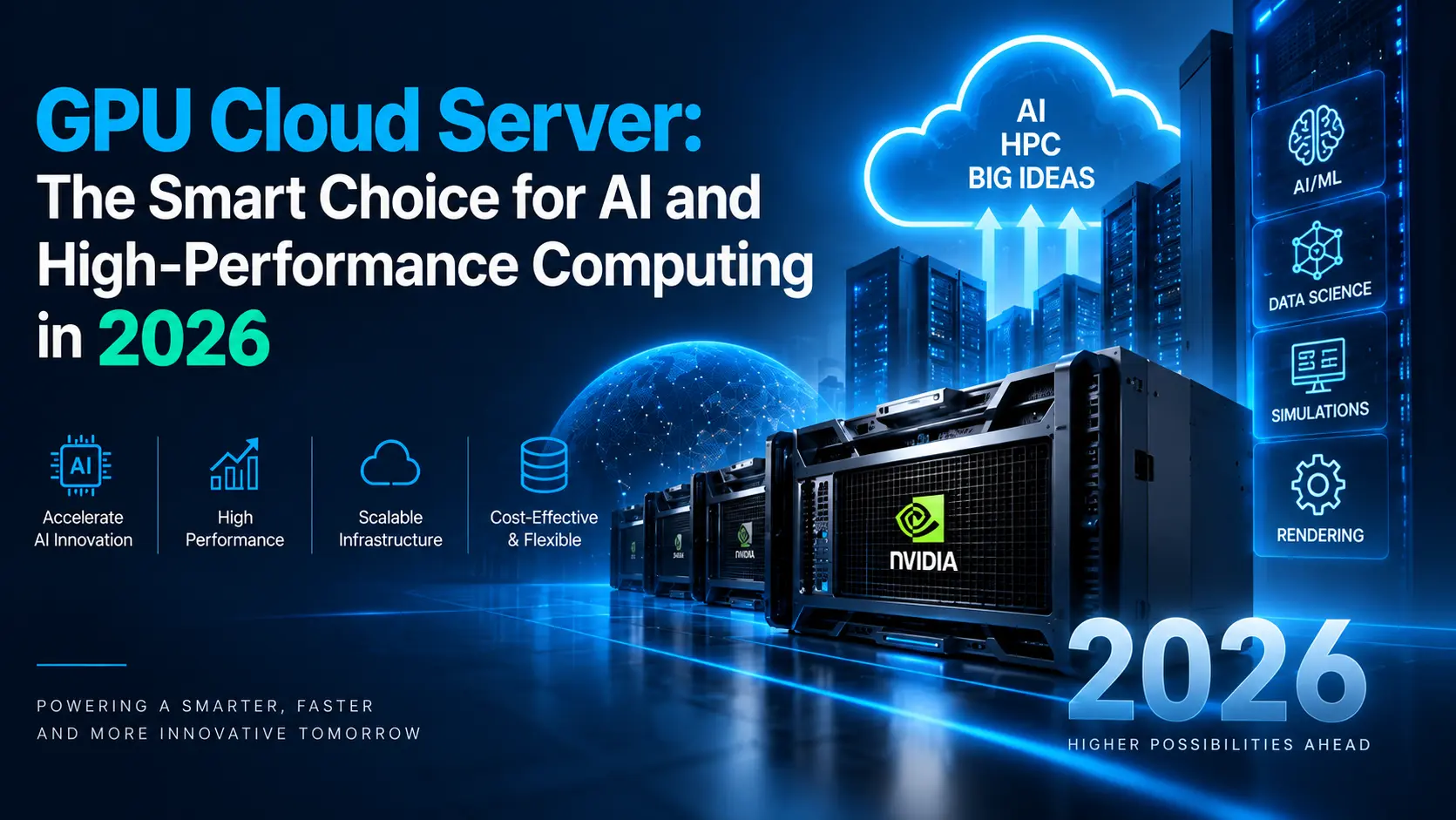
A GPU cloud server is a cloud-based machine equipped with one or more graphics processing units (GPUs), designed to handle workloads that require massive parallel computation. Instead of buying expensive hardware, users rent GPU computing power by the hour and access it remotely over the internet. In 2026, GPU cloud servers have become the standard infrastructure for AI training, deep learning, 3D rendering, scientific simulation, and large-scale data processing.
What is a GPU Cloud Server?
A GPU cloud server is a virtual or physical server instance that combines GPUs with standard server components—CPU, RAM, NVMe SSD storage, and high-bandwidth network connectivity. Unlike a CPU, which is designed for sequential processing with a small number of powerful cores, a GPU contains thousands of smaller cores optimized for parallel computation.
This architecture enables the simultaneous execution of thousands of mathematical operations, which is precisely what AI model training, deep learning inference, 3D rendering, and video processing workloads require. The “cloud” component means the GPU cloud server is hosted in a professional data center and accessed remotely, rather than installed on the customer’s premises.
How GPU Cloud Servers Work
GPU cloud servers operate through a simple workflow:
- Launch a GPU Instance: The cloud provider attaches a physical GPU to your virtual server using high-speed interconnects.
- Enable Drivers and Framework Access: Proper drivers allow AI frameworks to communicate effectively with the GPU.
- Submit Workloads: Users connect to the platform, select a GPU, and submit their workload.
- Process and Stream Results: The GPU uses parallel computing to process the task and streams the results back in real time.
Access is usually managed through a web interface, an API, or command-line tools, so users can easily integrate GPU cloud servers into existing workflows.
Key Use Cases for GPU Cloud Servers
GPU cloud servers are used across multiple industries and applications:
1. AI and Machine Learning
- Training: Run full model training jobs faster by using GPUs for heavy computation, making it practical to work with larger datasets and deeper architectures.
- Inference: Serve real-time predictions (chat, search ranking, image detection, fraud scoring) with lower latency and higher throughput.
- Fine-tuning: Customize pre-trained models for specific tasks without retraining from scratch.
2. Deep Learning and Research
Researchers and students use GPU cloud servers to experiment with neural networks, computer vision, and natural language processing without capital expense.
3. 3D Rendering and Visual Effects
Rendering houses and animation studios use GPU cloud servers for faster rendering times and scalable compute for visual effects, gaming, and virtual production.
4. Scientific Simulation and HPC
Scientific computing, genomics, climate modeling, and financial simulations benefit from the parallel processing power of GPU cloud servers.
5. Video Processing and Streaming
GPU cloud servers accelerate video encoding, transcoding, and real-time streaming for media platforms.
GPU Cloud Server vs. On-Premise GPU: Which to Choose?
The choice between GPU cloud and on-premise GPU depends on workload, budget, and operational needs.
| Criterion | GPU Cloud Server | On-Premise GPU Server |
| Cost Model | OpEx (pay-as-you-go) | CapEx (upfront hardware purchase) |
| Deployment Time | Minutes to hours | Weeks to months |
| Scalability | Flexible, on-demand | Requires additional hardware |
| GPU Upgrades | Managed by provider | Funded and managed by company |
| Infrastructure Control | High, but provider-dependent | Full control |
| Best Suited For | AI projects, testing, variable workloads | Continuous, compute-intensive workloads |
| Idle Cost | Pay only when running | Pay regardless of usage |
GPU cloud is ideal for experimental, short-duration, or highly variable workloads. On-premise GPU is better for continuous, compute-intensive workloads where full control and data sovereignty are critical.
Benefits of GPU Cloud Servers
GPU cloud servers offer several advantages over traditional on-premise GPU infrastructure:
- Immediate Scalability: Scale GPU resources up or down as needed without hardware procurement delays.
- No Hardware Depreciation: Avoid concerns about hardware lifecycle management and obsolescence.
- Pay-as-You-Go Pricing: Pay only for actual usage, reducing idle costs.
- Access to Latest GPUs: Rapid access to the latest GPU generations without capital expenditure.
- API Integration: Seamless integration with modern AI workflows and orchestration tools.
- Reduced Operational Overhead: The provider handles servers, power, cooling, and maintenance.
Why GPU Cloud Servers Matter in 2026
In 2026, AI models are growing larger, data pipelines are becoming heavier, and enterprises want GPU access without the burden of buying, cooling, and maintaining physical hardware. GPU cloud servers address these challenges by providing on-demand access to high-performance compute.
Cloud GPU resources scale up or down as required and match processing requirements with up-to-the-minute precision. For organizations running production AI on sensitive data, private cloud GPU options offer dedicated performance and data sovereignty without the operational overhead of traditional on-premise infrastructure.
Choosing the Right GPU Cloud Server
When selecting a GPU cloud server, consider the following:
- GPU Type and Availability: Ensure access to the right GPU models (e.g., H100, A100, L40S) for your workload.
- Pricing Model: Compare hourly billing, reserved capacity, and usage-based pricing.
- Performance: Evaluate performance for AI training, inference, rendering, and simulation.
- Ease of Deployment: Look for simple provisioning through APIs, Kubernetes, or one-click environments.
- Data Locality: Consider compliance and low-latency infrastructure requirements.
- Support for Enterprise Use Cases: Ensure compatibility with model training, VDI, and HPC.
- Storage Compatibility: Check integration with object storage and modern AI pipelines.
Final Thought
A GPU cloud server is more than just a virtual machine with a GPU. It is a flexible, scalable, and cost-effective solution for AI, deep learning, rendering, and high-performance computing. In 2026, as AI workloads expand and compute demands grow, GPU cloud servers will remain a strategic choice for organizations that want performance without the burden of owning and maintaining physical hardware.
