

Hospital Billing Software vs Manual Billing: Which Is Better for Your Hospital?
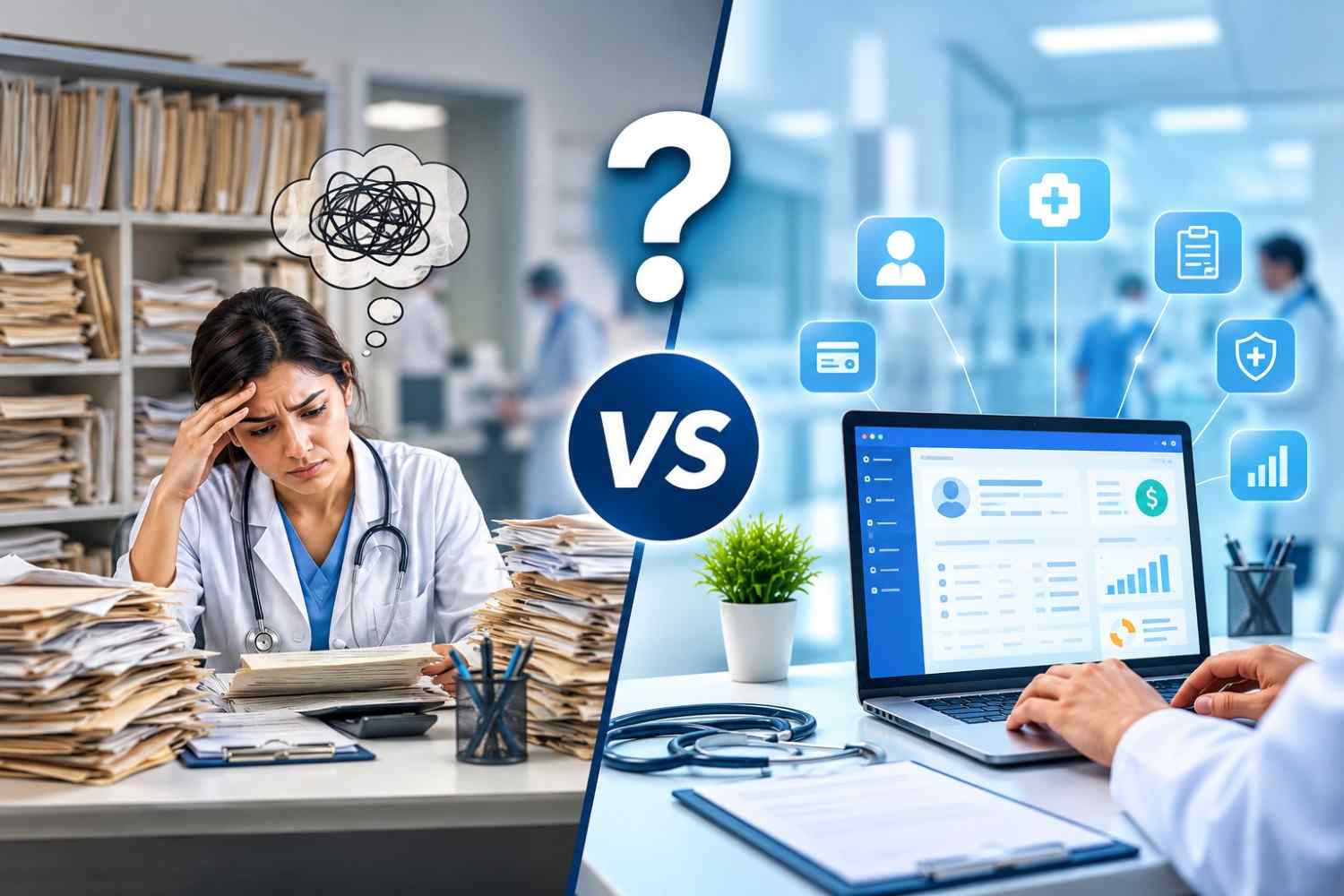
Imagine your billing team handling hundreds of patient charges every day using paper files, spreadsheets and manual calculations. One small mistake can lead to a wrong bill, a missed charge or a delayed insurance claim.
So, which is better for your hospital: manual billing or Hospital Billing Software In India? For most growing hospitals, software is the more practical choice because it can automate repetitive billing work, connect charges from different departments and give you clearer financial records. Manual billing may work for a very small setup, but it becomes harder to manage as your hospital grows.
What Is Manual Hospital Billing?
Manual billing means your staff record patient charges, payments, discounts and other financial details by hand or through basic spreadsheets.
Your billing team may need to collect information from registration, OPD, IPD, pharmacy, laboratory and other departments before preparing the final bill.
This process can work when the number of patients and services is low. But as your hospital becomes busier, keeping every charge accurate becomes more difficult.
What Is Hospital Billing Software?
Hospital billing software is a digital system that helps you manage the financial side of patient care.
You can use it to manage OPD and IPD billing, insurance and TPA billing, payments, advances, outstanding amounts, invoices and financial reports.
Modern systems can also connect billing with other hospital departments. For example, pharmacy and laboratory charges can flow into the patient’s financial record instead of being entered again manually.
This reduces repeated data entry and gives your team one place to manage billing information.
Manual Billing vs Hospital Billing Software
The biggest difference is how much work your staff have to do themselves.
With manual billing, your team enters and checks much of the information. With software, many routine tasks can be automated.
Here is a simple comparison:
| Area | Manual Billing | Hospital Billing Software |
|---|---|---|
| Data entry | Mostly manual | Automated in many workflows |
| Calculations | Staff must calculate | System can calculate charges |
| Patient ledger | Paper or spreadsheets | Central digital record |
| OPD/IPD billing | Separate manual work | Managed in one system |
| Insurance billing | Manual tracking | Digital claim tracking |
| Payment tracking | Difficult at scale | Easier to monitor |
| Reports | Takes more staff time | Generated quickly |
| Department integration | Limited | Can connect departments |
| Outstanding dues | Manual follow-up | Dedicated reports |
| Scalability | Becomes difficult | Better suited to growth |
1. Accuracy: Which Option Is Better?
Billing mistakes can create problems for both your hospital and your patients.
When your staff enter the same information several times, there is a greater chance of typing or calculation errors.
Hospital billing software can automate calculations and reduce repeated data entry. This does not mean mistakes become impossible, but it can reduce the amount of manual work involved.
For example, if a patient uses laboratory, pharmacy and inpatient services, connected systems can help bring these charges into the billing workflow.
2. Speed: Manual Billing Takes More Time
Think about your billing counter during a busy afternoon.
Your staff may need to check patient information, calculate charges, verify payments, prepare an invoice and answer questions about pending amounts.
When much of this work is manual, the process can take longer.
With billing software, you can automate routine calculations, generate invoices and check payment information from a central system. This allows your staff to spend less time on repetitive tasks.
3. Insurance and TPA Billing
Insurance billing can become difficult when you are managing many patients and different payers.
You may need to track claim information, submitted amounts, settlements, co-payments, deductibles and pending claims.
A digital system can make this information easier to organise.
This is also important as healthcare systems move towards greater digital exchange of health and claim information. The Ayushman Bharat Digital Mission (ABDM) is working towards a connected digital health ecosystem, including digital health records and digital health transactions.
The NABH Digital Health Standards also recognise the importance of using a digital system to manage insurance claims in hospitals.
4. Managing OPD and IPD Billing
Your hospital may handle hundreds of OPD visits while also managing IPD patients.
With manual billing, keeping these workflows organised can require separate records and repeated entries.
Hospital billing software can bring OPD and IPD billing into one workflow.
You can manage patient charges, packages, settlements and payments while keeping the financial information connected to the patient’s record.
5. Pharmacy and Laboratory Charges
A patient’s final bill may include more than doctor consultation or room charges.
It can include medicines, laboratory tests, diagnostic services and other hospital services.
If these charges are maintained separately, your billing staff may have to collect the information and enter it again.
Software that integrates pharmacy and laboratory information can reduce this repeated work. It can help billing information flow from connected departments into the patient’s financial record.
6. Payment and Outstanding Amounts
Knowing how much money is pending is important for your hospital’s financial management.
With spreadsheets or paper records, finding old outstanding payments can take time.
A billing system can help you track cash, credit, advances and pending amounts from one place.
You can also generate reports showing outstanding dues and collections, making it easier for your finance team to follow up.
7. Reports and Financial Visibility
When you rely on manual records, preparing a detailed financial report can take considerable staff effort.
You may need to collect information from different files and spreadsheets before you can understand your hospital’s collections.
With billing software, reports can be generated from structured billing data.
For example, you may want to review daily revenue, department-wise collections or outstanding payments. Having these reports available can help you understand where money is coming from and where payments are still pending.
8. Manual Billing Can Become Harder as Your Hospital Grows
Manual billing is not automatically wrong.
If you operate a very small facility with a low number of patients and simple billing requirements, a basic process may be manageable.
The problem starts when your hospital grows.
More patients mean more bills. More departments mean more charges. More insurance and TPA relationships mean more information to track.
At that point, the question is not simply whether manual billing is possible. You should ask whether it is still efficient, accurate and easy for your team to control.
9. What Should You Look for in Hospital Billing Software?
If you are considering a billing system, do not choose one only because it has a long list of features.
First, think about your hospital’s actual workflow.
You may need OPD and IPD billing, insurance and TPA management, cash and credit handling, advance management, pharmacy and laboratory integration, financial reports and tax or discount management.
You should also consider whether the system can grow with your hospital.
Cloud access, user permissions, data security, backups, support and training are also important points to discuss with a software provider.
10. Is Hospital Billing Software Worth It for Indian Hospitals?
For a growing hospital, the value is not only about generating invoices.
The bigger benefit is having a more organised billing process.
A suitable system can connect patient billing with payments, insurance, pharmacy, laboratory and financial reporting. It can also reduce repetitive manual work and make important financial information easier to access.
For hospitals in India, you should also consider how the software fits your local billing and reporting workflow.
For example, MediTale’s hospital billing solution is designed for Indian hospitals and includes OPD/IPD billing, insurance and TPA management, cash, credit and advance management, reporting, pharmacy and laboratory integration, and tax and discount management.
When Should You Move From Manual Billing to Software?
There is no single patient number at which every hospital must change its billing system.
Instead, look at the problems you are facing.
Are your staff spending too much time entering the same information? Are you finding it difficult to track outstanding payments? Are insurance claims becoming harder to manage? Do you struggle to prepare reports quickly?
If the answer is yes to several of these questions, it may be time to consider a digital billing system.
Final Verdict: Manual Billing or Hospital Billing Software?
Manual billing can be simple at a small scale, but it becomes harder to control when your hospital grows.
Hospital Billing Software is generally the better option for a growing hospital because it can reduce repetitive work, organise financial information, connect billing with other departments and make reporting easier.
The right choice still depends on your hospital’s size, workflow, budget and requirements.
Instead of choosing software simply because it has many features, look for a solution that fits the way your hospital actually works.
Ready to Make Hospital Billing Simpler?
If your billing team is spending too much time on manual entries, spreadsheets, payment tracking or insurance paperwork, it may be worth looking at a more organised digital workflow.
MediTale’s Hospital Billing Software is designed for small and medium hospitals and supports OPD/IPD billing, insurance and TPA billing, payment management, financial reports and integration with pharmacy and laboratory workflows.
You can explore MediTale’s hospital billing solution to see whether its features match your hospital’s billing needs, or book a demo to discuss your workflow before making a decision.
