

Jacketed High-Pressure Autoclave Reactor vs Limpet Coil Reactor
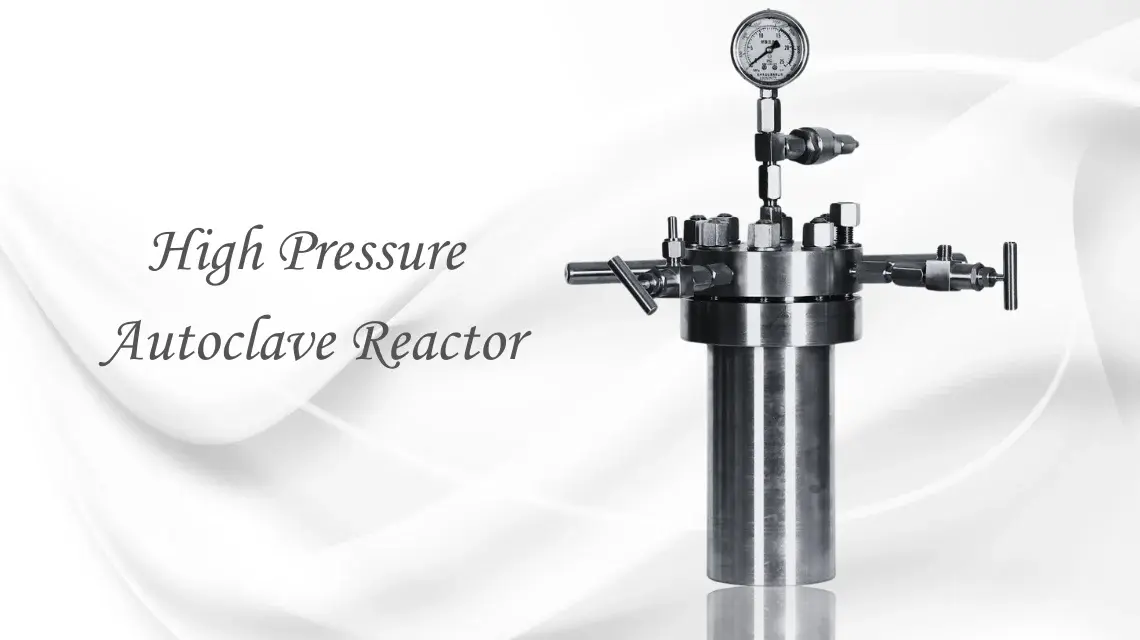
Industrial reactors are the central component of chemical, pharmaceutical, and petrochemical process lines. What separates a productive reactor from a bottleneck is heat transfer efficiency. A reactor that heats too slowly stalls batch cycles. One that doesn’t cool well risks uncontrolled reactions or ruined product. When specifying a new vessel, process engineers often consider two options – the jacketed high-pressure autoclave reactor and the limpet coil reactor. Both are about cooling and heating. They do it quite differently, and that makes a difference in cycle time, capital cost, and safety margins.
What is a Jacketed High Pressure Autoclave Reactor?
Design and Construction of Jacketed Reactor
A jacketed autoclave reactor is one in which the inner shell carries the process fluid and an outer shell forms a sealed jacket around the inner shell. The jacket cavity is filled with heating or cooling medium (steam, thermic fluid, cooled water, or brine). The inner shell wall thickness is 12 to 40 mm and is designed for internal pressures up to 100 bar.
Key Features of a High Pressure Autoclave Reactor
High-pressure autoclave reactors handle pressures from 10 up to 350 bar and temperatures between minus 20°C and 350°C. The controlled environment suits catalytic hydrogenation, high-pressure polymerization, and specialty pharmaceutical synthesis where pressure, temperature, and gas phase must stay within tight limits.
Understanding the Design of a Limpet Coil Reactor
How a Limpet Coil Reactor Works
The limpet coil reactor consists of a half-pipe coil welded spirally around the outside shell of the vessel. The external coil channel is an effective circulating channel for heating or cooling material from a lower intake to an upper outlet. The total heat transfer rate per square metre is highly dependent on certain design characteristics such as coil pitch, half-pipe diameter (50–150 mm), and fluid flow velocity. This arrangement provides uniform thermal control over the whole chemical process.
Industrial Applications
Limpet coil reactors are well-suited to industrial processes requiring slow, controlled heating and cooling of large batch volumes. They are widely used in the synthesis of resins, the formulation of adhesives, in bulk chemical processing, and large-scale industrial mixing. These systems are very well adapted for applications with thermal loads distributed over hours and not over minutes, and with modest reaction rates. They give safe, uniform and very predictable product yields.
Jacketed High-Pressure Autoclave Reactor vs Limpet Coil Reactor: Design Comparison
Structurally, a jacketed reactor wraps the vessel in a full annular cavity, while a limpet coil wraps it in a discrete welded channel. Heat transfer in the jacket happens across the full outer wall at once. In the coil, it happens along the half-pipe weld interface. Jacket-side pressure typically caps at 6 to 10 bar, while limpet coils handle 15 to 20 bar in the coil channel, allowing higher-velocity thermic fluids.
Heat Transfer Efficiency and Temperature Control
Heating and Cooling Performance in Jacketed Reactors
Jacketed designs deliver uniform temperature distribution because the medium contacts the full circumference of the vessel wall at every point. Overall heat transfer coefficients range from 400 to 800 W/m²K depending on medium and stirring. That uniformity suits sensitive reactions where local hot spots would degrade product or trigger side reactions.
Thermal Performance of Limpet Coil Reactors
Limpet coils achieve higher medium-side velocities and turbulent flow inside the half-pipe, pushing heat transfer coefficients to 600 to 1,200 W/m²K on the coil side. Heat transfer is concentrated along the coil path rather than uniform, which suits large-batch processes tolerant of small temperature gradients across the vessel height.
Pressure Handling Capabilities and Process Safety
Jacketed autoclave reactors handle internal pressures of 10 to 350 bar with rated safety valves, rupture disks, and interlock controls. Limpet coil reactors typically operate at lower internal pressures, up to 25 bar in most builds. Reactor choice depends on the reaction’s peak pressure, exothermic profile, and the plant’s safety integrity level. High-pressure hydrogenation or oxidation demands the jacketed autoclave.
Suitability for Different Industrial Applications
Applications Best Suited for High Pressure Autoclave Reactors
Hydrogenation reactions running at 50 to 200 bar. Catalyst research where controlled pressure and stirring matter. Pharmaceutical active ingredient manufacture where batch purity drives product acceptance. Specialty chemical synthesis with tight temperature and pressure envelopes.
Applications Commonly Using Limpet Coil Reactors
Alkyd, epoxy, and polyester resin manufacturing at 5,000 to 30,000 litre batch sizes. Bulk chemical processing where batch times run 8 to 24 hours. Industrial mixing and reaction processes with moderate heat loads and low-pressure operation.
Maintenance and Operational Considerations
Jacketed reactors need periodic inspection of the annular cavity for fouling, corrosion, and weld seam integrity. Cleaning requires draining, flushing, and sometimes chemical descaling. Limpet coils allow easier external weld inspection and thermography, but coil channel cleaning demands mechanical scraping or high-pressure jetting through the coil path. Both designs run 15 to 25 years with scheduled maintenance and correct medium chemistry.
Energy Efficiency and Process Optimization
Reactor design shapes energy use directly. Jacketed reactors lose heat across the full outer jacket surface, requiring insulation thickness of 75 to 100 mm to hold efficiency above 85 percent. Limpet coil designs expose less surface area to ambient losses. That gives limpet designs a small efficiency edge on large vessels running steady-state, while jacketed reactors respond faster to setpoint changes on batch processes.
Cost Considerations Between Jacketed and Limpet Coil Reactors
Jacketed reactor fabrication runs 20 to 40 percent more expensive per liter of working volume than a limpet coil equivalent at the same capacity, driven by double-shell construction and higher wall thickness above 50 bar. Operating cost per batch differs too: jacketed designs consume more medium per cycle because the annular cavity holds a larger fluid inventory. Lifecycle value depends on batch frequency and product margin.
Factors to Consider When Selecting the Right Reactor Design
Process Parameters That Influence Reactor Selection
Operating pressure caps at 25 bar favor limpet coils. Pressures above 50 bar require jacketed autoclaves. Fast exothermic reactions with tight temperature control demand the uniform heat transfer of a jacket. Batch volumes above 10,000 litres often make limpet coils more cost-effective. High peak loads over short cycles suit jackets, sustained moderate loads suit coils.
Industry-Specific Requirements and Compliance Considerations
ASME Section VIII Division 1 and 2 codes govern pressure vessel design in most jurisdictions. Pharmaceutical builds add cGMP surface finish requirements (Ra below 0.4 microns) and material traceability. Material selection covers 316L, Hastelloy C276, or titanium depending on reaction chemistry and chloride exposure.
Choosing the Appropriate Reactor Configuration for Process Efficiency
Match reactor design to the production goal. High-value pharmaceutical or specialty batches justify the jacketed autoclave for control and safety margin. High-volume bulk chemistry justifies the limpet coil for capital efficiency. Thermal management, safety, and cycle time all factor in, and a wrong choice adds 15 to 30 percent to total ownership cost over service life.
Conclusion
Jacketed high-pressure autoclave reactors and limpet coil reactors solve different process problems. The jacketed autoclave delivers pressure capability, uniform heat transfer, and tight control for sensitive reactions. The limpet coil offers cost-effective heat transfer on large batch volumes at moderate pressure. Reactor choice depends on pressure, temperature, batch size, reaction chemistry, and lifecycle cost. Suppliers such as Tinita Manufacturing, De Dietrich, and Buchi Glas Uster build both configurations to project-specific specifications, so selection comes down to matching design to process.
