

The Biggest Barriers to Enterprise AI Adoption and How to Overcome Them
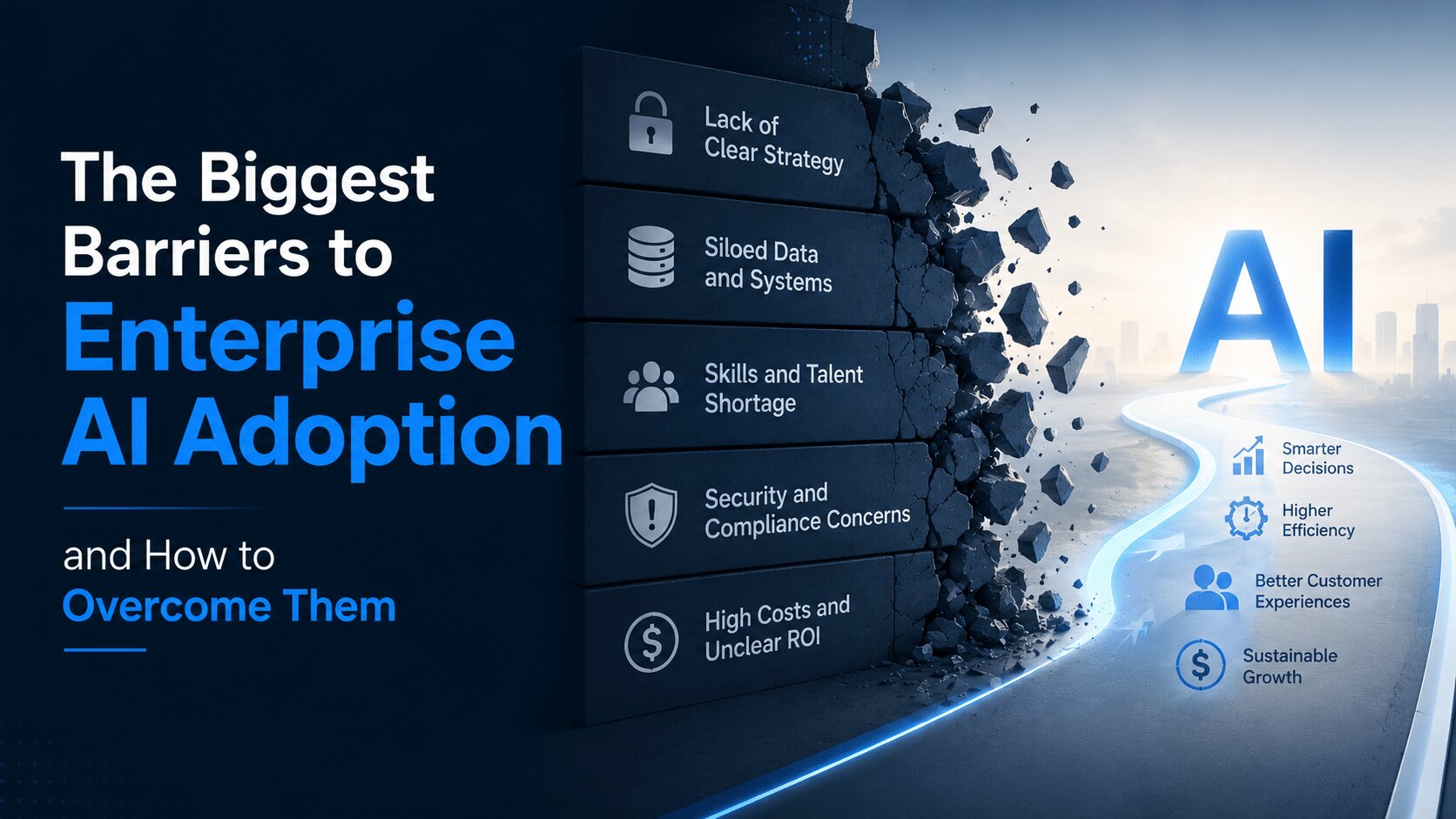
Artificial intelligence has moved from research labs into enterprise operations, where it supports customer service, software development, cybersecurity, supply chain planning, and business analytics. The rapid advancement of generative AI has further accelerated enterprise interest, prompting organizations to evaluate how AI can improve operational efficiency, decision-making, and knowledge management. However, despite growing investment, many AI initiatives struggle to move beyond pilot projects.
Recent market research reflects both the momentum and the challenges surrounding enterprise AI adoption. According to McKinsey & Company, nearly 65% of organizations reported using generative AI in at least one business function in 2024, almost double the adoption rate seen a year earlier. Gartner predicts that by 2026, more than 80% of enterprises will have used generative AI APIs or deployed generative AI-enabled applications in production environments. At the same time, IBM’s Global AI Adoption Index found that concerns around data quality, skills shortages, and governance remain among the leading obstacles preventing organizations from scaling AI initiatives successfully.
These findings highlight an important reality: adopting AI is no longer the primary challenge. Building reliable, secure, and scalable AI systems that deliver measurable business outcomes is where most enterprises encounter difficulties.
Why Enterprise AI Projects Stall
Organizations often begin with enthusiasm by testing chatbots, document assistants, or predictive models. Initial demonstrations generate interest because AI performs well in controlled environments using limited datasets.
The complexity emerges during enterprise deployment.
Production environments require AI systems to integrate with business applications, comply with security policies, process sensitive data, support thousands of users, and produce consistent results. Many pilot projects fail because they overlook these operational requirements.
Successful AI adoption depends as much on enterprise architecture, governance, and data maturity as it does on the underlying AI model.
Barrier 1: Poor Data Quality
AI systems depend on accurate and well-managed data.
Many enterprises operate with fragmented information spread across CRM platforms, ERP systems, cloud applications, data warehouses, spreadsheets, and legacy databases. Duplicate records, inconsistent formats, and missing values reduce model reliability and increase the risk of inaccurate outputs.
For example, a customer service assistant trained on outdated product documentation may provide incorrect responses, while an AI forecasting model using incomplete sales data can produce misleading business recommendations.
How to Address It
Organizations should establish a strong data foundation before deploying AI widely.
Key practices include:
- Defining enterprise data governance policies
- Standardizing data models
- Removing duplicate records
- Validating data quality regularly
- Creating centralized knowledge repositories
- Monitoring data lineage and ownership
Improving data quality benefits AI initiatives while also strengthening analytics, reporting, and operational decision-making.
Barrier 2: Legacy Systems and Integration Challenges
Enterprise environments rarely consist of modern cloud-native applications alone.
Many organizations continue to rely on legacy ERP systems, on-premises databases, proprietary software, and custom business applications that were never designed for AI integration.
Without reliable connectivity, AI systems cannot access the business information required to produce meaningful recommendations.
How to Address It
Modern AI implementations should rely on API-first integration strategies and middleware platforms rather than direct point-to-point connections.
Organizations should prioritize:
- REST and GraphQL APIs
- Enterprise integration platforms
- Event-driven architectures
- Secure identity management
- Data synchronization frameworks
This approach improves interoperability while reducing future integration complexity.
Barrier 3: Security and Compliance Concerns
Enterprise AI systems frequently process confidential information, including customer records, financial data, intellectual property, healthcare information, and internal business documents.
Without proper governance, AI can introduce risks related to unauthorized access, data leakage, or regulatory non-compliance.
Industries such as banking, healthcare, and government face particularly strict security and privacy obligations.
How to Address It
Security should remain part of AI architecture from the beginning.
Organizations should implement:
- Role-based access controls
- Encryption for data at rest and in transit
- Audit logging
- Secure API authentication
- Data masking for sensitive information
- Human approval for high-risk AI outputs
Regular security reviews and compliance assessments help reduce operational risk as AI deployments expand.
Barrier 4: Limited Internal AI Expertise
Many enterprises possess strong software engineering capabilities but limited experience in machine learning operations, prompt engineering, retrieval-augmented generation (RAG), model evaluation, and AI governance.
As a result, organizations often struggle to move from proof-of-concept projects to production-grade deployments.
How to Address It
Building AI capability requires both technical and organizational investment.
Organizations can:
- Train existing engineering teams
- Establish cross-functional AI governance groups
- Hire AI specialists where necessary
- Develop internal AI usage standards
- Partner with experienced technology advisors
Working with a Generative AI consulting Service can help enterprises evaluate suitable use cases, design scalable architectures, establish governance frameworks, and integrate AI solutions into existing technology ecosystems without disrupting ongoing operations.
Barrier 5: Lack of Clear Business Objectives
Many AI projects begin with technology-first thinking rather than business priorities.
Organizations experiment with generative AI because of market interest but struggle to define measurable success criteria.
Without clearly defined objectives, projects often deliver interesting demonstrations without producing operational value.
How to Address It
Every AI initiative should begin with a specific business problem.
Examples include:
- Reducing customer support response times
- Improving sales forecasting accuracy
- Accelerating document processing
- Enhancing fraud detection
- Supporting software development
- Improving knowledge retrieval for employees
Success metrics should align with operational KPIs rather than technical model performance alone.
Barrier 6: Managing AI Accuracy and Trust
Generative AI models occasionally produce inaccurate or fabricated responses, commonly referred to as hallucinations.
In enterprise environments, unreliable outputs can affect customer service, legal compliance, financial reporting, and operational decisions.
Trust therefore, becomes a critical adoption factor.
How to Address It
Organizations should avoid relying exclusively on publicly trained language models for enterprise knowledge.
Instead, they should combine foundation models with Retrieval-Augmented Generation (RAG), allowing AI systems to retrieve information from approved internal documentation before generating responses.
This approach improves response accuracy while maintaining traceability to trusted enterprise content.
Human review remains essential for high-impact decisions involving legal, financial, or regulatory matters.
Barrier 7: Scaling Beyond Pilot Projects
Many enterprises successfully demonstrate AI capabilities within small pilot programs but struggle when expanding deployment across departments.
Common scaling challenges include:
- Infrastructure costs
- Model monitoring
- Version control
- Performance optimization
- Governance consistency
- User adoption
How to Address It
Organizations should adopt an enterprise AI operating model that includes:
- Standardized deployment practices
- Model lifecycle management
- Continuous monitoring
- Performance benchmarking
- User training
- Governance reviews
Treating AI as an enterprise platform rather than an isolated project supports sustainable long-term adoption.
Real-World Enterprise Example: Morgan Stanley
A strong example of enterprise AI adoption comes from Morgan Stanley, which implemented a generative AI assistant to help financial advisors access internal research and knowledge more efficiently.
Instead of relying solely on public AI models, the organization integrated approved internal documentation into its AI system. Advisors could retrieve relevant information faster while maintaining compliance with strict financial regulations.
The initiative demonstrated that enterprise AI delivers greater value when organizations prioritize governance, trusted knowledge sources, and clearly defined business use cases over broad experimentation.
Measuring Business Impact
Enterprise AI initiatives should be evaluated using operational and financial outcomes rather than adoption rates alone.
Common performance metrics include:
- Reduced document processing time
- Faster customer response times
- Lower operational costs
- Improved employee productivity
- Higher knowledge retrieval accuracy
- Increased first-contact resolution rates
- Reduced manual effort in repetitive workflows
Organizations often find that the greatest return on investment comes from applying AI to repetitive, information-intensive processes where measurable efficiency gains can be tracked over time.
Final Thoughts
Enterprise AI adoption is no longer limited by the availability of technology. The larger challenge lies in building AI systems that integrate effectively with existing business processes, operate securely, and deliver reliable outcomes at scale.
Organizations that invest in strong data governance, modern integration architectures, security controls, and measurable business objectives are better positioned to move beyond isolated pilot projects. Equally important is developing internal expertise and establishing governance frameworks that support responsible AI adoption across the enterprise.
For businesses beginning or expanding their AI journey, working with an experienced Generative AI consulting Service can provide valuable technical guidance on architecture, implementation, governance, and integration. Combined with a clear business strategy, this approach helps organizations deploy AI solutions that support long-term operational goals while maintaining security, compliance, and organizational trust.
