

5 Things I Wish I Knew Before Applying for an SBA Acquisition Loan to Buy a Business
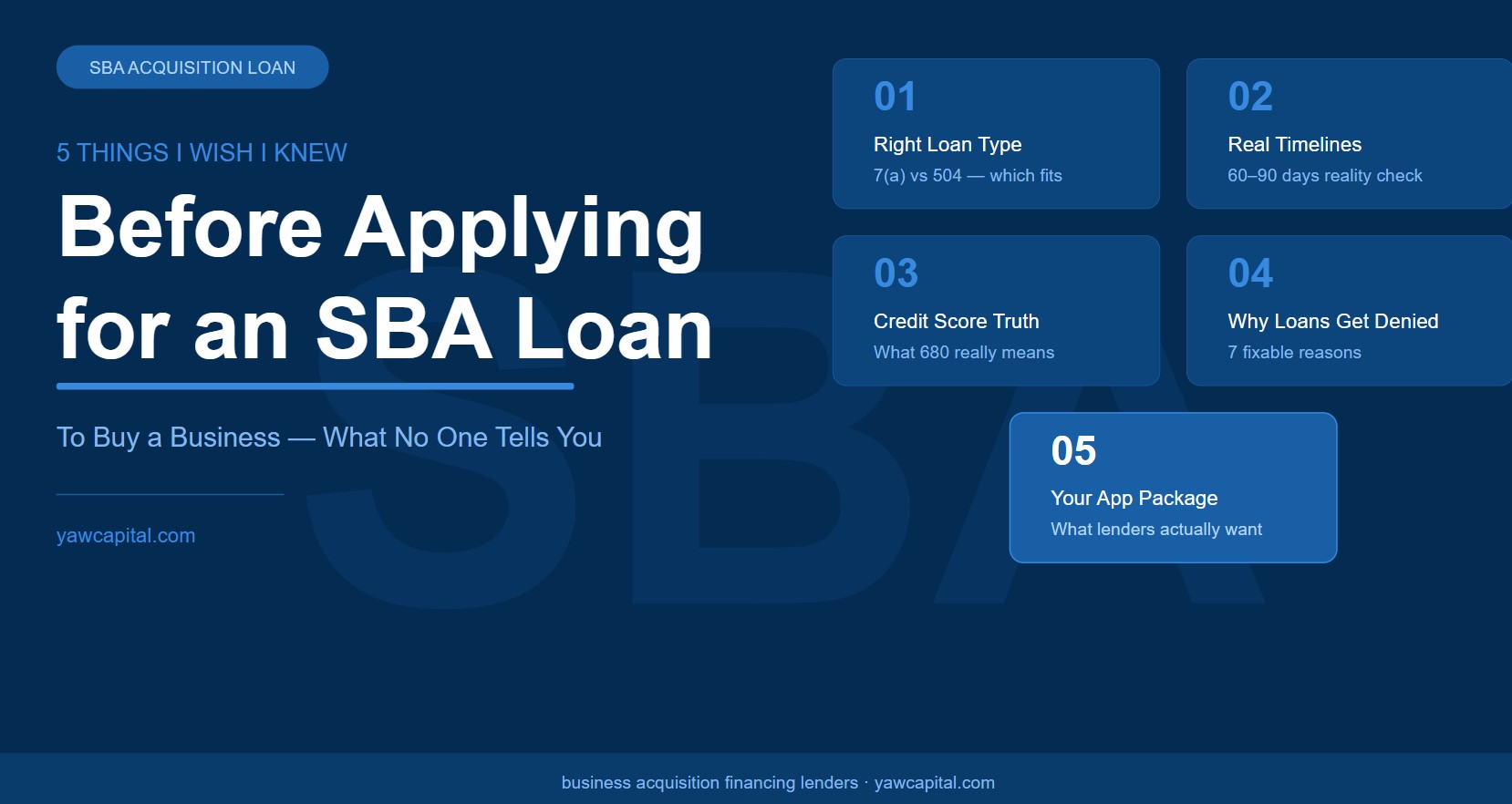
Nobody tells you how much you don’t know until you’re deep in a business acquisition deal and your lender starts asking for documents you’ve never heard of. I’ve been there watching a clean, promising deal get complicated by avoidable financing mistakes. If you’re planning to use an SBA acquisition loan to buy a business this guide covers the five things that trip up buyers the most, which loan to choose, how long it really takes, what your credit score actually means, why loans get denied and how to build an application package that closes.
Let’s get into it — no fluff.
1. SBA 7(a) vs SBA 504: Which Loan Is Actually Right for Buying a Business?
This is the question I get more than almost any other and honestly the confusion is understandable. Both are SBA-backed. Both have competitive rates. But they’re built for completely different purposes and picking the wrong one wastes everyone’s time.
SBA 7(a) Loans: The Default Choice for Business Acquisitions
The SBA 7(a) is the workhorse of business acquisition financing. It can fund up to $5 million and covers a broad range of uses: the purchase price of the business, working capital, equipment goodwill and even leasehold improvements. If you’re buying an operating business, a dental practice a trucking company, a franchise, an eCommerce brand the 7(a) is almost certainly the right tool.
Repayment terms go up to 10 years for working capital and business acquisitions and up to 25 years when real estate is involved. Interest rates are variable and tied to the prime rate with the SBA setting maximum spreads. As of 2024 rates on 7(a) loans have generally ranged between 10.5% and 13.5% depending on loan size and terms though these shift with the broader rate environment.
One thing I noticed when working through deals: lenders have a lot of discretion in how they underwrite 7(a) loans. Two lenders looking at the same deal can reach very different conclusions. That’s not a flaw, it’s actually an opportunity if you know how to find the right lender for your specific industry and deal size.
SBA 504 Loans: Built for Real Assets, Not Pure Business Acquisitions
The SBA 504 is a fantastic product but it’s designed for purchasing fixed assets like commercial real estate and heavy equipment. If you’re buying a business that also owns the building it operates from a 504 can cover the real estate portion while a 7(a) handles the business purchase itself. But if you’re just buying a business as an operating entity the 504 alone won’t work.
The structure of a 504 is also different. It involves three parties, a conventional lender covering 50% a Certified Development Company (CDC) backed by the SBA covering 40%, and the buyer contributing 10%. The process is more complex and the use-of-funds restrictions are tighter.
short way: If you’re buying a business start with the SBA 7(a). If that business also includes commercial real estate talk to your financing advisor about whether a blended 7(a)/504 structure makes sense. Yaw Capital structures both types of deals and can help you figure out which combination actually fits your transaction.
2. How Long Does SBA Loan Approval Really Take? The Timeline Nobody Warns You About
I’ll be straight with you. The SBA loan process takes longer than most buyers expect and underestimating it has killed more deals than bad credit scores have.
A standard Guide sba 7(a) loans for business acquisitions generally follows the timeline below:
Weeks 1–2: Application prep and lender submission.
This assumes your documents are already in order which most buyers’ aren’t when they start. If you’re gathering personal tax returns business financials and a business plan from scratch add another week or two.
Weeks 3–6: Lender underwriting.
The lender reviews your application, orders a business valuation (required for most acquisitions) and may request additional documents. This stage can stretch if the business has complex financials, real estate or if the lender’s pipeline is heavy.
Weeks 6–10: SBA review (if required).
Not all SBA loans require direct SBA review Preferred Lender Program (PLP) lenders have delegated authority to approve loans in-house which skips this step. If your lender isn’t a PLP lender the application goes to the SBA for review adding two to four weeks.
Weeks 10–12+: Closing.
Title work lease assignments, lien searches and document preparation take time. Even after a loan is approved when closing can take two to three weeks.
Total realistic timeline? 60 to 90 days from a clean complete submission. Deals with real estate complex ownership structures or incomplete documentation regularly stretch to 120 days or more.
Here’s the insight that most SBA loan articles skip entirely: the clock doesn’t start when you sign an LOI. It starts when you submit a complete application. Buyers who treat prequalification as optional often sign a contract with a 60-day closing window and then scramble to pull a financing package together. That’s where deals fall apart.
Getting prequalified before you make an offer and knowing upfront which lenders have PLP status in your deal’s state — is what separates buyers who close from buyers who don’t. Yaw Capital’s prequalification service gives you a real financing picture in days including lender match and deal structure so you walk into an LOI with a timeline that’s actually achievable.
3. What Credit Score Do You Need for an SBA Business Acquisition Loan?
The magic number most lenders cite is 680. That’s the floor for serious SBA lender consideration. Below 680, your options get narrow fast and the ones that remain tend to come with tougher terms.
But this is important, credit score is one factor, not the whole story. Here’s how lenders actually think about it:
Your personal credit score signals character and reliability. It tells the lender whether you’ve historically kept your commitments. But when you’re buying an existing business, lenders are also evaluating the business itself, its revenue consistency, its debt service coverage ratio (DSCR) the industry it operates in and whether its cash flow can actually support the loan payments.
The SBA’s minimum requirement is technically no specific credit score the SBA defers to lenders to set creditworthiness standards. In practice, most active SBA acquisition lenders want 680+ personal credit, though some will consider lower scores with compensating factors (strong business cash flow, significant buyer equity injection, relevant industry experience).
What actually matters more than a perfect score is demonstrating no recent derogatory marks specifically no bankruptcies in the last three years, no active judgments and no pattern of late payments. A 695 credit score with a clean recent history is often more financeable than a 720 score with a foreclosure two years ago.
One thing I’d add: if your score is in the 650–679 range, don’t give up. Work with a lender who’s relationship-driven rather than algorithmically rigid. Building a strong buyer profile relevant experience, solid equity injection and a well-prepared business plan can tip the decision. The right lender match matters as much as the number itself.
4. SBA Loan Denied? 7 Reasons Lenders Reject Acquisition Loans (And How to Fix Them)
Getting a denial letter is rough. But in my experience most SBA acquisition loan denials are fixable. The key is understanding why it happened, not just that it did.
1. Insufficient cash flow in the target business.
Insufficient cash flow in the target business. Lenders typically look for a Debt Service Coverage Ratio (DSCR) of at least 1.25x, which means the business should generate enough cash flow to cover its loan payments with a comfortable cushion. If the numbers are too tight lenders may see the deal as higher risk.
Fix: Consider negotiating a lower purchase price or structuring part of the deal as a seller note. Either approach can reduce the amount that needs to be financed and improve the loan’s overall cash flow coverage.
2.Too little buyer equity injection.
SBA loans typically require 10–30% equity from the buyer. If you’re light on cash, some lenders will decline outright.
Fix: negotiate a seller note as partial equity, bring in a co-borrower, or find deals in a lower price range until your capital position improves.
3.Limited industry or management experience.
Lenders want to know you can actually run this business. If you’re buying a healthcare practice with no medical background, or a manufacturing company with no operations experience, that’s a red flag.
Fix: hire a strong general manager with industry experience, or partner with someone who fills the gap and document it clearly.
4.Wrong lender for the industry.
Not every SBA lender understands every business type. A lender who’s great at retail acquisitions might decline an eCommerce deal simply because they don’t know how to underwrite ARR.
Fix: apply to a lender who’s done deals in your industry. This is where lender-matching services genuinely earn their value.
5.Business financials have red flags.
Tax returns that don’t match bank statements. Revenue concentrated in one or two clients. A key employee who’s leaving post-sale. Lenders see these as risk signals.
Fix: address them directly in your application narrative don’t hope the underwriter won’t notice.
6.Issues with the deal structure itself.
If the purchase price is above what a lender’s appraisal supports they’ll decline or counteroffer.
Fix: get an independent business valuation before you submit your application so there are no surprises.
7.Incomplete or inconsistent documentation.
This sounds basic, but it’s more common than you’d think. A personal financial statement that doesn’t match the tax returns or a business plan with revenue projections that contradict the historical financials create credibility problems.
Fix: build your document package carefully and have someone with SBA experience review it before submission.
A denial from one lender is not a closed door. It’s a data point. Understanding the reason and correcting it is the path forward.
5. How to Prepare Your SBA Loan Application Package: What Lenders Actually Want
The buyers who close SBA acquisition deals fastest are the ones who had their document package ready before they found the business. I know that sounds backwards but think about it your personal financial profile doesn’t change based on which business you’re buying. Get that part built now.
What You Need to Provide as the Buyer
Lenders will ask for your last three years of personal tax returns (all schedules included not just the first two pages). A completed personal financial statement which is SBA Form 413 available on the SBA website and relatively straightforward to complete. A professional resume or biography that speaks specifically to your business management experience, not just your career history. A business plan and yes this needs to be actual substance not a template. Your lender wants to understand your plan for operating and growing the acquisition, your assumptions and your financial projections for the first three years. Finally, proof of your equity injection, recent bank statements, investment account statements or documentation of gift funds if applicable.
What You Need from the Seller
Three years of business tax returns. Current year profit and loss statement (within 90 days). A balance sheet. A list of all significant assets, equipment, vehicles, inventory. Copies of any major customer contracts, vendor agreements and lease documents. And for deals above $2–3 million most lenders will require a Quality of Earnings (QoE) report from an independent accounting firm. Some sellers resist this but it protects both sides and almost always speeds up underwriting.
The One Thing Most Application Guides Miss
Here’s a detail that rarely makes it into SBA loan checklists: the business acquisition narrative. This is a memo typically two to four pages that tells the story of the deal from your perspective. Who you are, why this business, what you’re paying and why it’s a fair price, how you’ll operate it and what risks you’ve identified and how you’ll manage them.
Underwriters aren’t robots. They read your file and form an opinion. A clear confident narrative that acknowledges risks rather than ignoring them builds trust. I’ve seen deals with average financials close because the buyer’s narrative was compelling and thorough. And I’ve seen deals with excellent numbers struggle because the buyer’s package felt disorganized and vague.
Build your package like you’re making a case not filling out a form. Because that’s exactly what you’re doing.
For a complete overview of how acquisition financing works from start to finish including how to choose the right deal structure and what lenders really care about read our full guide.
FAQ
Can I use an SBA acquisition loan to buy a franchise?
Yes. Franchise acquisitions are among the smoother SBA deals to close. Most established brands are on the SBA’s Franchise Directory, which speeds up lender review. You’ll still need solid personal financials and strong unit performance.
What’s the maximum SBA 7(a) loan amount for buying a business?
$5 million. For larger acquisitions, capital markets financing applies blending conventional debt, mezzanine financing, and seller notes based on deal size and complexity.
Do SBA loans require collateral?
Not strictly. The business assets typically serve as collateral, and personal real estate may be likened if available. Cash flow and repayment ability come first. Lack of collateral alone won’t disqualify you.
What if the landlord won’t assign the lease?
It can kill the deal. Lenders often won’t proceed if the business can’t guarantee its location. Get written landlord consent or negotiate a new lease before going deep into the loan process.
Are SBA loan rates fixed or variable?
Most SBA 7(a) loans are variable, tied to the prime rate plus a lender spread. SBA 504 loans carry a fixed rate on the CDC portion. Model both scenarios when projecting deal cash flow.
Ready to Find Out Where You Stand?
The SBA acquisition loan process rewards preparation. Buyers who understand the difference between loan types start building their document package early and get prequalified before making offers consistently outperform buyers who treat financing as an afterthought.
If you’re serious about buying a business and want a real picture of your financing options not a generic rate quote but an actual lender match based on your profile and deal type Yaw Capital is built for exactly this. Their team works exclusively in business acquisition financing across SBA 7(a), conventional and capital markets deals. Reach out before you make your next offer. It might be the most valuable call you make in this process.
