

How AI Is Transforming Software Development Services for Enterprise in 2026
Key Takeaways
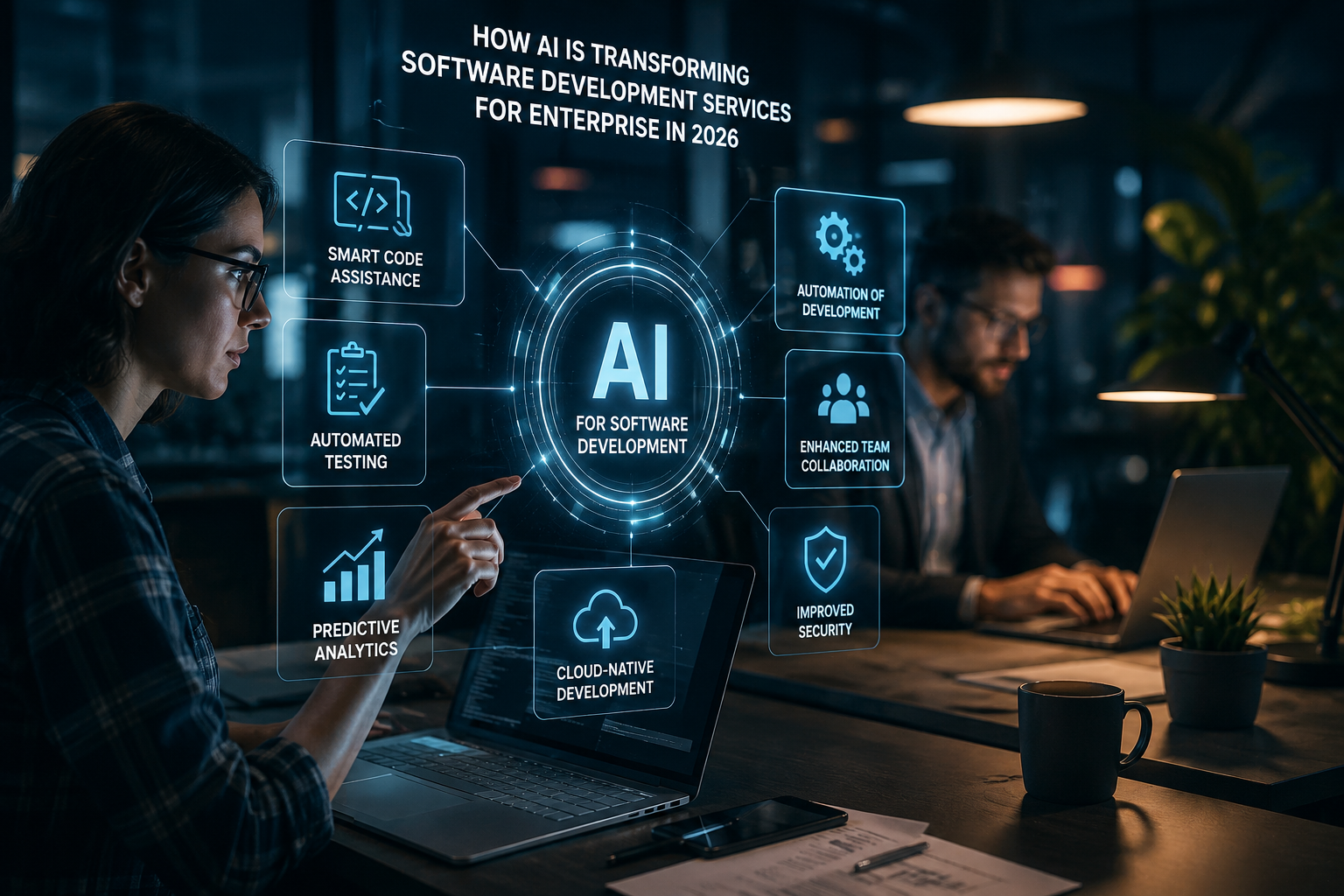
- Artificial intelligence in enterprise software is no longer an experimental layer; it is actively embedded in how code is written, tested, deployed, and maintained, compressing development cycles that previously took months into weeks.
- Enterprises that have integrated AI-driven development workflows are reporting measurable reductions in bug rates, faster time to production, and significantly lower cost per feature delivered compared to traditional software development processes.
- AI-powered software development services are shifting engineering teams from routine implementation tasks toward higher-value work like architecture design, business logic refinement, and product strategy.
- The software development process in 2026 is defined by automation at every layer, from requirement analysis and code generation through testing, security scanning, and deployment pipeline management.
- Enterprise AI adoption in software engineering is not uniform; the companies achieving the strongest outcomes are those that have embedded AI tools into structured workflows rather than leaving individual developers to explore tools independently.
- Custom AI-powered business solutions built on mature enterprise architectures are outperforming generic SaaS products for organizations with complex workflows, regulated data environments, and deep integration requirements.
- The gap between enterprises that have rebuilt their software development process around AI capabilities and those that have not will become structurally difficult to close within the next 18 to 24 months.
The Software Team Next to You Is Building Twice as Fast
Engineering output is no longer solely a function of headcount. In 2026, a 10-person development team equipped with the right AI-driven development infrastructure is outpacing a 25-person team running a traditional software development process on nearly every measurable dimension: lines of shipped code, defect density, deployment frequency, and time to resolve production incidents.
This is not a prediction about the future of software. It is a description of what is already happening inside engineering organizations at companies like Google, Microsoft, Goldman Sachs, and Shopify, and increasingly at mid-market enterprises that have made deliberate investments in AI-powered software development services over the past 18 months.
For technology leaders, product owners, and executives at growing enterprises, the strategic question is no longer whether AI will transform how software gets built. It already has. The question is how quickly your organization closes the capability gap and what a mature, AI-integrated development function actually looks like in practice.
The Problem With Traditional Enterprise Software Development
Enterprise software development has always carried structural inefficiencies that the industry treated as unavoidable: long requirement cycles, manual code reviews, slow testing pipelines, fragile deployment processes, and the constant drag of technical debt accumulation. For decades, the primary levers for improving output were hiring more engineers and adopting better project management frameworks.
Neither lever scales cleanly. Senior engineers are expensive and scarce. Agile methodologies improve workflow visibility but do not fundamentally change the ratio of engineering hours to shipped functionality. The result is that most enterprises run software development operations where a significant portion of engineering capacity is consumed by activities that AI can now perform faster and more accurately.
Where the Inefficiency Actually Lives
Understanding where AI-driven development creates the most value requires being specific about where time goes in a traditional software development process:
Requirement interpretation and specification: Engineers spend significant time translating ambiguous business requirements into technical specifications. Misinterpretation at this stage creates rework that compounds through every subsequent phase.
Boilerplate and repetitive code: A substantial portion of code written in any enterprise codebase is structural: authentication flows, API endpoint scaffolding, database schema migrations, error handling patterns. This code follows known patterns and requires time but not creative engineering judgment.
Testing and quality assurance: Manual test writing and execution is one of the largest consumers of engineering capacity in enterprise teams. Test coverage is frequently insufficient because writing tests manually is time-consuming, and the cost of that insufficiency shows up as production incidents.
Code review cycles: Human code review is valuable for architectural decisions and complex logic, but much of what code review catches, style violations, security antipatterns, performance inefficiencies, are detectable by automated analysis that runs in seconds rather than hours.
Deployment and environment management: Configuration management, environment provisioning, and deployment pipeline troubleshooting consume engineering hours that have nothing to do with building product features.
Each of these inefficiency categories is now addressable through AI-powered software development services with measurable precision.
How Artificial Intelligence Is Embedded in the Modern Software Development Process
The impact of artificial intelligence on software engineering is not concentrated in one phase of the development lifecycle. It touches every stage, creating a compounding acceleration effect that is only visible when you map the full workflow.
AI in Requirement Analysis and Technical Specification
Large language models trained on code, documentation, and software architecture patterns can now process business requirement documents and produce structured technical specifications, data models, and API contracts with a level of accuracy that reduces the interpretation gap between business stakeholders and engineering teams.
Tools like GitHub Copilot for Docs, Notion AI, and enterprise-specific requirement analysis systems are already being used by engineering organizations at JPMorgan, Accenture, and SAP to reduce the specification-to-kickoff cycle from days to hours. The output is not perfect and requires engineering review, but the starting point is materially better than a blank document.
AI-Assisted Code Generation and Completion
Code generation is the most widely adopted form of AI-driven development currently in enterprise use. GitHub Copilot, Amazon CodeWhisperer (now integrated into Amazon Q Developer), and Google’s Gemini Code Assist have moved from experimental to production-standard tools inside engineering organizations at enterprises ranging from Airbus to Walmart.
The impact on productivity is well-documented. GitHub’s own research on Copilot adoption found that developers completed tasks up to 55% faster with AI assistance. More meaningfully for enterprise teams, the gains were largest on the high-volume, lower-complexity work that consumes the most time: boilerplate code, test generation, documentation, and routine implementation.
What this means for enterprise AI adoption in software engineering is that the most immediate ROI does not come from asking AI to solve hard architectural problems. It comes from automating the work that was never hard but was always time-consuming.
Automated Testing and Quality Assurance
Test coverage is one of the most persistent quality problems in enterprise codebases. Writing comprehensive tests manually is time-consuming enough that most engineering teams accept lower coverage than they know is safe, and the technical debt of insufficient testing accumulates quietly until it manifests as a production incident.
AI-powered testing tools like Diffblue Cover (which automatically generates Java unit tests), Mabl, and Testim use machine learning to generate, maintain, and evolve test suites as the codebase changes. The result is higher coverage without the proportional increase in engineering hours that manual test writing would require.
For enterprises in regulated industries where test documentation is a compliance requirement, automated test generation with AI also produces the audit trail that manual processes frequently fail to maintain consistently.
AI in Code Review and Security Scanning
Static analysis and security scanning tools have existed for years, but their false positive rates made them frustrating to use in practice. AI-powered code review tools like Snyk, SonarQube’s AI features, and Amazon CodeGuru apply machine learning models trained on millions of code repositories to distinguish genuine security vulnerabilities and performance issues from noise.
The practical impact is that security review, which was previously a specialist activity performed periodically, becomes a continuous, automated part of the software development process. Vulnerabilities are caught at the point of code creation rather than weeks later in a dedicated review cycle. For enterprises dealing with GDPR, HIPAA, PCI-DSS, or SOC 2 compliance requirements, shifting security left through AI-powered analysis is both a quality improvement and a risk reduction.
Development Workflow Automation: The Architecture of a Modern AI-Integrated Pipeline
Software deployment automation is the second major vector through which AI is transforming enterprise software delivery, distinct from the code-creation improvements described above. A modern enterprise development pipeline in 2026 looks fundamentally different from the CI/CD pipelines that were considered best practice five years ago.
What a Mature AI-Integrated Development Pipeline Includes
Intelligent test selection: Rather than running the full test suite on every code commit, AI-powered pipeline tools analyze which tests are relevant to the specific changes made and run only those, reducing pipeline execution time while maintaining confidence in the change.
Predictive rollout management: AI models trained on deployment history can predict whether a given release has elevated risk based on the characteristics of the changes, the deployment window, the health of dependent services, and historical incident patterns. Teams at companies like Netflix and Spotify use these signals to decide whether to proceed with a deployment, slow-roll it to a subset of users, or hold for additional validation.
Automated incident detection and triage: AIOps platforms like PagerDuty, Dynatrace, and Datadog apply anomaly detection models to production telemetry to identify incidents earlier, correlate related signals across distributed systems, and surface probable root causes faster than manual analysis.
Self-healing infrastructure: Kubernetes-based environments with AI-assisted orchestration can now detect degraded service performance and automatically adjust resource allocation, restart failed components, or route traffic away from unhealthy nodes without human intervention. This capability is moving from large-scale cloud-native organizations into mid-market enterprise deployment environments.
The cumulative effect of these automations is that development workflow automation is reducing the mean time to detect, mean time to resolve, and the operational overhead of managing production environments in ways that free engineering capacity for building product features rather than managing infrastructure.
AI Use Cases in Enterprise Application Development: Industry-Specific Impact
![Examples of AI use cases in enterprise application development across banking, healthcare, manufacturing, and retail]
The impact of AI on enterprise software development is not uniform across industries. Understanding where the most significant value is being created helps enterprise leaders prioritize their investments.
Financial Services and Banking
Banks and financial institutions are using AI-powered software development services to accelerate the modernization of legacy systems that were built on COBOL or older Java architectures and now represent both a maintenance burden and a competitive liability. AI-assisted code translation tools can analyze legacy COBOL code, understand its business logic, and generate equivalent modern code in Java or Python that can be validated against the original system’s behavior.
Goldman Sachs has publicly discussed its investment in AI-assisted developer tools as part of its engineering productivity strategy. The institution’s scale, hundreds of millions of lines of code across trading systems, risk management platforms, and client-facing applications, makes AI augmentation of the development process a structural necessity rather than an optional improvement.
Healthcare and Life Sciences
Healthcare software development carries compliance requirements that make automated testing, audit trail generation, and security scanning particularly valuable. AI-powered development tools that integrate with FDA 21 CFR Part 11 and HIPAA compliance frameworks are reducing the documentation overhead that previously made healthcare software development significantly more expensive per feature than development in non-regulated industries.
Epic Systems, Cerner (now part of Oracle Health), and a growing number of digital health startups are using AI to accelerate the development of clinical decision support features, predictive risk models, and patient engagement tools that require both rapid iteration and rigorous validation.
Manufacturing and Industrial Automation
Enterprise AI adoption in manufacturing software development is focused on predictive maintenance applications, digital twin systems, and supply chain optimization tools. These applications require tight integration between software development and operational technology environments, and AI-powered development tools are helping bridge the gap between IT and OT development practices that have historically operated with different methodologies, different toolchains, and different release cadences.
Siemens, Bosch, and Honeywell are among the enterprises that have invested significantly in AI-powered development workflows for their industrial software platforms, with documented improvements in deployment frequency and reduction in integration-related incidents.
Retail and eCommerce
Retail enterprises are using AI-driven development to accelerate the iteration cycles for personalization engines, inventory management systems, and customer experience platforms. The competitive dynamics of retail, where the speed of feature delivery directly affects conversion rates and customer retention, make development workflow automation particularly valuable.
Amazon’s internal development practices have long been cited as a benchmark for continuous delivery, and the integration of AI tools into those practices is accelerating an already fast development culture. For other retailers competing in the same space, the use of AI-powered software development services is increasingly a matter of competitive survival rather than optional optimization.
Enterprise Software Development Trends in 2026
The enterprise software development landscape in 2026 is shaped by several converging trends that technology leaders need to understand to make sound investment decisions.
Platform Engineering and Internal Developer Platforms
Enterprise AI adoption is accelerating the shift toward platform engineering, where a dedicated team builds and maintains an internal developer platform that abstracts infrastructure complexity and provides development teams with self-service capabilities for provisioning environments, managing deployments, and accessing shared services.
AI is embedded in these platforms at multiple levels: intelligent environment provisioning, automated cost optimization for cloud resources, AI-powered debugging tools, and natural language interfaces that allow developers to query production systems without writing custom scripts.
AI Agents in the Software Development Workflow
The emergence of AI agents that can execute multi-step software development tasks autonomously is the frontier of enterprise AI adoption in engineering. Tools like Devin (from Cognition AI), SWE-agent, and Amazon Q Developer’s agent capabilities can take a natural-language description of a task, explore a codebase, write the implementation, run tests, and open a pull request with minimal human intervention.
These capabilities are not yet production-ready for complex enterprise tasks that require deep organizational context and nuanced judgment. But for well-defined, bounded tasks such as dependency updates, routine bug fixes, and new endpoint implementation following established patterns, they are delivering measurable productivity gains in teams at Microsoft, Atlassian, and other enterprises that have piloted them in controlled environments.
Observability and AI-Powered Monitoring
The software deployment automation trend is extending beyond the deployment pipeline into production observability. AI-powered monitoring platforms can now correlate anomalies across logs, metrics, traces, and user behavior signals to identify the root cause of production incidents faster than any human analysis team.
Datadog’s Watchdog, Dynatrace’s Davis AI, and New Relic’s AI observability features are moving from premium add-ons to core infrastructure components for enterprises that run distributed systems with hundreds or thousands of microservices.
How to Evaluate AI-Powered Software Development Services
For enterprise leaders making sourcing decisions about software development services with AI capabilities, the evaluation framework below reflects the criteria that consistently differentiate high-performing engagements from disappointing ones.
AI Toolchain Integration vs Genuine AI-Native Development
The distinction between a development team that uses GitHub Copilot and a team that has built AI into its end-to-end workflow is significant. Ask prospective partners specifically:
- Which AI tools are integrated at which stages of your development process?
- How do you measure the productivity impact of AI assistance on your team?
- Can you show examples of AI-assisted deliverables from previous enterprise engagements?
- How do you handle AI-generated code that introduces security vulnerabilities or architectural antipatterns?
A team that can answer these questions with specificity has genuine experience. A team that gestures broadly at “AI tools” without operational detail is likely describing aspiration rather than practice.
Enterprise Security and Compliance Posture
AI-powered software development services introduce data security considerations that traditional development engagements did not raise. Specifically, code sent to external AI completion services may include proprietary business logic, credential patterns, or sensitive data structures. Enterprise partners should have clear policies on:
- Which AI tools are approved for use with enterprise codebases
- Whether AI tools are configured to prevent training on proprietary code
- How AI-assisted code is reviewed for security before deployment
- Compliance with enterprise data governance requirements for AI tool usage
Measurement and Accountability
Any serious provider of AI-powered software development services should be able to quantify the value they deliver. The metrics that matter for AI-integrated development engagements include deployment frequency, change failure rate, mean time to recovery, test coverage percentages, and the ratio of feature development time to maintenance time. If a partner cannot establish baseline measurements and commit to improvement targets against these metrics, the AI component of their service offering is likely cosmetic.
FAQs
1. What is AI-powered software development and how does it differ from traditional development?
AI-powered software development integrates artificial intelligence tools and models at multiple stages of the software development process, including requirement analysis, code generation, automated testing, code review, security scanning, deployment pipeline management, and production monitoring. Traditional development relies on human engineers for all of these activities. The practical difference is that AI-powered development teams produce more code, at higher quality, with fewer defects, in less time. The most significant gains come not from replacing engineers but from automating the high-volume, lower-complexity work that consumes engineering capacity in traditional teams.
2. How are enterprises using AI to improve software development outcomes?
Enterprises are using AI to improve software development in five primary ways: accelerating code production through AI completion tools like GitHub Copilot and Amazon Q Developer; improving test coverage through automated test generation; reducing security vulnerabilities through continuous AI-powered scanning; compressing deployment cycles through intelligent pipeline automation; and reducing mean time to recovery through AI-powered observability and incident triage. The enterprises achieving the strongest outcomes are those that have embedded these capabilities into structured, team-wide workflows rather than leaving individual developers to adopt tools independently.
3. What are the most important enterprise software development trends in 2026?
The most significant enterprise software development trends in 2026 are the mainstreaming of AI coding assistants from experimental to standard tooling, the emergence of AI agents capable of autonomous multi-step development tasks, the accelerating adoption of platform engineering to standardize AI-augmented developer experiences at scale, the integration of AI into production observability for faster incident detection and resolution, and the use of AI-assisted code translation to modernize legacy systems without full rewrites.
4. How do AI-powered business solutions differ from off-the-shelf enterprise software?
AI-powered business solutions built as custom applications differ from off-the-shelf enterprise software in three critical ways. First, they can be designed around the specific data structures, workflow patterns, and integration requirements of your organization rather than requiring your organization to adapt to a generic product’s architecture. Second, the AI models embedded in custom solutions can be trained on your organization’s proprietary data, making their predictions and recommendations significantly more accurate than those of a generic model. Third, custom solutions do not carry the licensing, per-seat pricing, and vendor dependency risks that accompany major enterprise SaaS commitments.
5. What should enterprises look for when selecting AI-driven development partners?
Enterprises evaluating AI-driven development partners should look for demonstrated experience integrating specific AI tools at specific stages of the development lifecycle, not just general claims about using AI. They should assess the partner’s security posture around AI tool usage with proprietary codebases, their ability to establish baseline development metrics and commit to measurable improvements, their familiarity with the compliance requirements relevant to your industry, and their post-delivery model for maintaining and evolving AI-assisted systems over time.
Conclusion
The transformation of software development through artificial intelligence is not a future state that enterprise leaders need to prepare for. It is a present reality that is already reshaping the competitive dynamics between organizations that have rebuilt their engineering practices around AI capabilities and those that are still running development processes that were designed for a pre-AI context.
The enterprises winning in this environment are not necessarily the largest or the ones with the most engineers. They are the ones that have made deliberate, structured investments in AI-powered software development services, embedded AI tools into team-wide workflows with clear quality controls, and built the measurement practices to understand where the value is being created and how to accelerate it.
The compounding nature of the advantage matters. A business that starts building AI into its development process today will have 18 months of data, tooling refinement, and team capability development that a competitor starting in 2027 cannot immediately replicate. The time to act is before the gap becomes obvious, not after.
